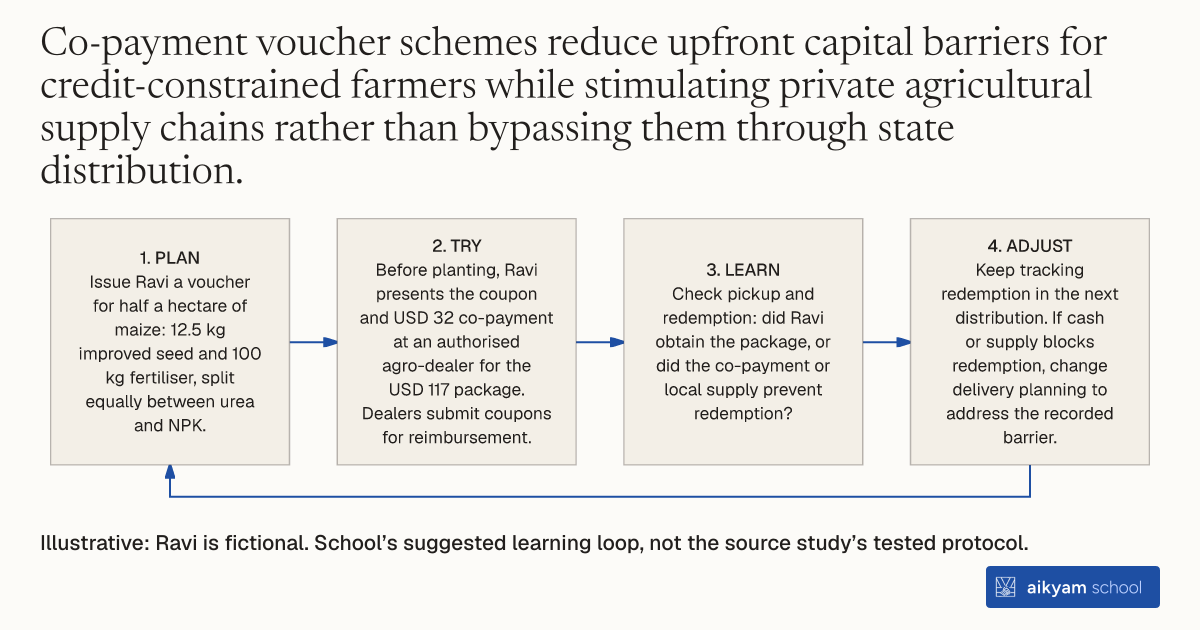
Try, learn and adjust
Check voucher packages and redemption requirements
- Plan: Issue Ravi a voucher for half a hectare of maize: 12.5 kg improved seed and 100 kg fertiliser, split equally between urea and NPK.
- Try: Before planting, Ravi presents the coupon and USD 32 co-payment at an authorised agro-dealer for the USD 117 package. Dealers submit coupons for reimbursement.
- Learn: Check pickup and redemption: did Ravi obtain the package, or did the co-payment or local supply prevent redemption?
- Adjust: Keep tracking redemption in the next distribution. If cash or supply blocks redemption, change delivery planning to address the recorded barrier.
Illustrative: Ravi is fictional. School’s suggested learning loop, not the source study’s tested protocol.
See source →School’s suggested learning loop, not a source-tested procedure. Observe coupon pickup, cash barriers and input supply. The voucher covers USD 85; this check does not establish crop effects.
How
When to use
Smallholder farmers in developing regions often underutilize modern agricultural inputs due to severe liquidity constraints and risk aversion. Traditional universal subsidies are costly and distort commercial markets, while unassisted markets fail to reach poor farmers. This method provides temporary, co-paid subsidy vouchers that enable resource-constrained farmers to adopt modern seed and fertilizer packages through private retailer networks.
Distribute co-paid input subsidy vouchers that entitle targeted smallholders to purchase standardized agricultural input packages from local private agro-dealers.
- Design a standardized input package tailored for half a hectare of target crop production containing improved seeds and complementary fertilizers.
- Structure the voucher to cover the majority of the market cost while requiring a mandatory cash co-payment paid directly by the farmer upon redemption.
- Issue paper voucher coupons to selected farmers through local agricultural extension service offices prior to the planting season.
- Authorize private agro-dealers to accept the voucher coupons alongside the farmer's cash co-payment as full payment for the package.
- Require participating agro-dealers to submit redeemed voucher coupons to the program management entity for financial reimbursement.
Why it works
Requiring a beneficiary cash contribution screens for committed producers and ensures efficient public fund utilization.
Example
In Manica Province, Mozambique, the Ministry of Agriculture piloted a voucher program for 12,500 smallholder maize farmers. Each voucher underwrote a package for a half-hectare of maize containing 12.5 kg of improved seeds and 100 kg of fertilizer (50 kg urea, 50 kg NPK). Farmers paid a \$32 co-payment (27% of the \$117 total market value), with the coupon covering the remaining \$85 subsidy value at local agro-dealers.
About the study
Participants
N = 1,436 smallholder maize producers (795 treatment group voucher lottery winners, 798 control group losers; 84% male, 76% literate) in Manica Province, Mozambique.
Study Design
Randomized Controlled Trial (RCT) evaluating a 73% subsidized input voucher package valued at USD 117 with a 27% (USD 32) farmer co-payment.
Results
Using the voucher for maize production increased fertilizer use by 68.3 kg (p < 0.01) and improved seed use by 14.4 kg (p < 0.01) among active redeemers, though only 28% of voucher winners redeemed coupons for maize due to cash co-payment constraints (46% non-pickups cited lacking USD 32) and local supply shortages.