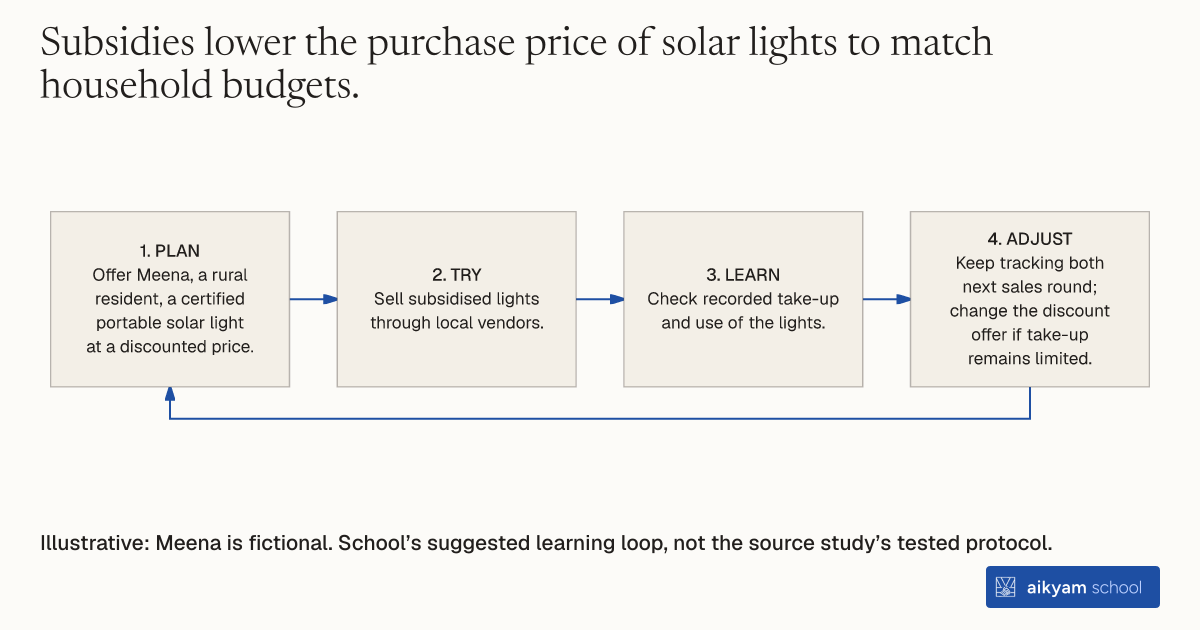
Try, learn and adjust
Check take-up of subsidised solar lights
- Plan: Offer Meena, a rural resident, a certified portable solar light at a discounted price.
- Try: Sell subsidised lights through local vendors.
- Learn: Check recorded take-up and use of the lights.
- Adjust: Keep tracking both next sales round; change the discount offer if take-up remains limited.
Illustrative: Meena is fictional. School’s suggested learning loop, not the source study’s tested protocol.
See source →School’s suggested, untested loop. Observe take-up and use; no reduction in kerosene use is assumed.
How
When to use
Low-income rural families often rely on expensive kerosene because market prices for off-grid solar lights are too high. Program managers offer price subsidies to lower the retail cost of portable solar lights. This helps poor households transition from dirty fuel to clean electric lighting.
Offer price subsidies on portable off-grid solar lights to increase adoption among low-income rural households.
- Local distributors import certified portable solar lights for retail sales in rural areas.
- Program administrators set discount rates to lower retail prices below standard market rates.
- Retail vendors offer subsidized solar lights to rural families in target communities.
- Program evaluation staff record household take-up rates and monitor light usage across communities.
Why it works
Reducing initial costs allows low-income families to switch away from ongoing kerosene purchases.
Example
In Cameroon and Kenya, researchers evaluated price subsidies for solar lights, finding that market-price adoption was only 29 and 31 percent, whereas discounted prices substantially increased household demand.
About the study
Participants
Low-income rural households in Cameroon, Kenya, India, and Rwanda.
Study Design
Randomized Controlled Trials evaluating household demand for off-grid solar lights across varying price and subsidy levels.
Results
At full market price, only 29 percent of households in Cameroon and 31 percent of households in Kenya purchased a solar light. Across studies in Cameroon, India, Kenya, and Rwanda, demand for off-grid solar products was significantly higher when offered at subsidized prices.