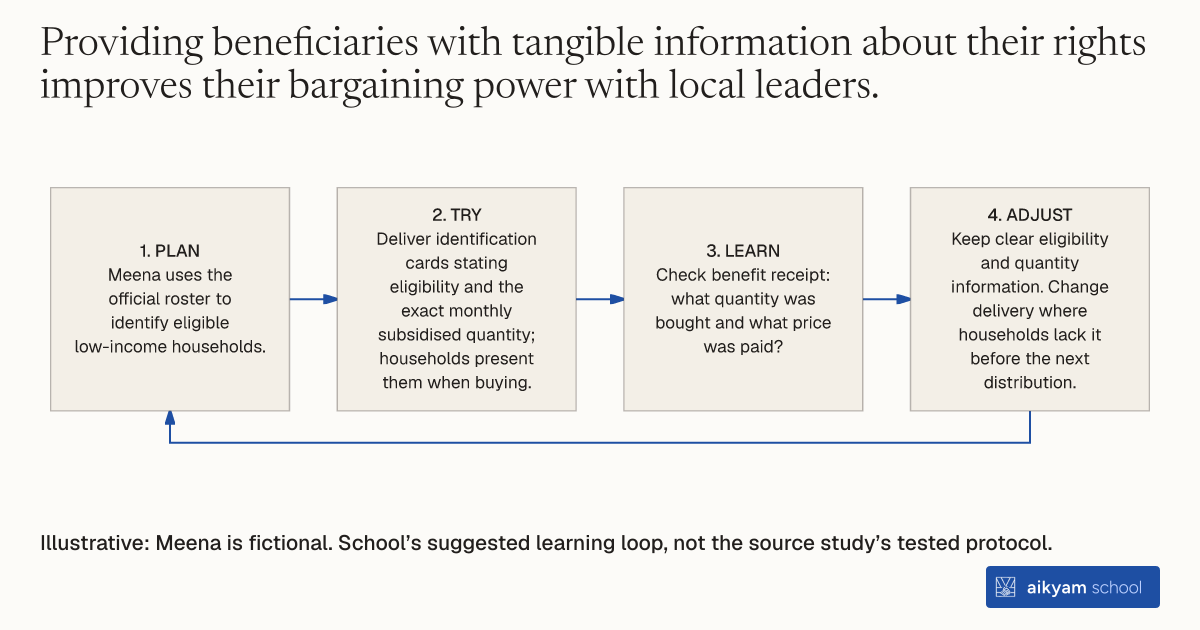
Try, learn and adjust
Check benefit information reaches eligible households
- Plan: Meena uses the official roster to identify eligible low-income households.
- Try: Deliver identification cards stating eligibility and the exact monthly subsidised quantity; households present them when buying.
- Learn: Check benefit receipt: what quantity was bought and what price was paid?
- Adjust: Keep clear eligibility and quantity information. Change delivery where households lack it before the next distribution.
Illustrative: Meena is fictional. School’s suggested learning loop, not the source study’s tested protocol.
See source →Observe eligibility information, rice quantity and prices paid; this check alone does not establish impact. School suggests this learning loop; it is not the source’s tested procedure.
How
When to use
Social assistance programs often face corruption, leakage, and inflated prices from local officials. Beneficiaries frequently lack clear information about their official program entitlements. Distribute basic identification cards to eligible low-income households to inform them of their official status and benefit quantities.
Distribute basic social benefit identification cards to targeted households to inform them of their program rights and benefit amounts.
- Identify eligible low-income households using an official government roster.
- Mail or deliver paper identification cards directly to each eligible household.
- Print clear information on the card stating the household's official eligibility status.
- Include details on the card specifying the exact monthly quantity of subsidized goods the household can buy.
- Instruct beneficiaries to show their card to local officials when purchasing their subsidized items.
Why it works
This increased transparency reduces corruption and prevents officials from diverting benefits.
Example
In Indonesia, the national government mailed basic identification cards to eligible households in a subsidized rice program across 378 villages. Households receiving cards gained 26 percent more total benefits over eighteen months because they bought more rice and paid lower prices.
About the study
Participants
572 villages across three provinces in Indonesia, targeting low-income households eligible for the Raskin subsidized rice program.
Study Design
Randomized controlled trial comparing 378 treatment villages receiving card interventions against 194 comparison villages operating under the status quo over an eighteen-month evaluation period.
Results
Basic identification cards increased total benefits received by eligible households by 26 percent, increased average quantity of rice received by 24 percent, reduced average prices paid by 2.5 percent, and reduced overall program leakage by 33 to 58 percent.