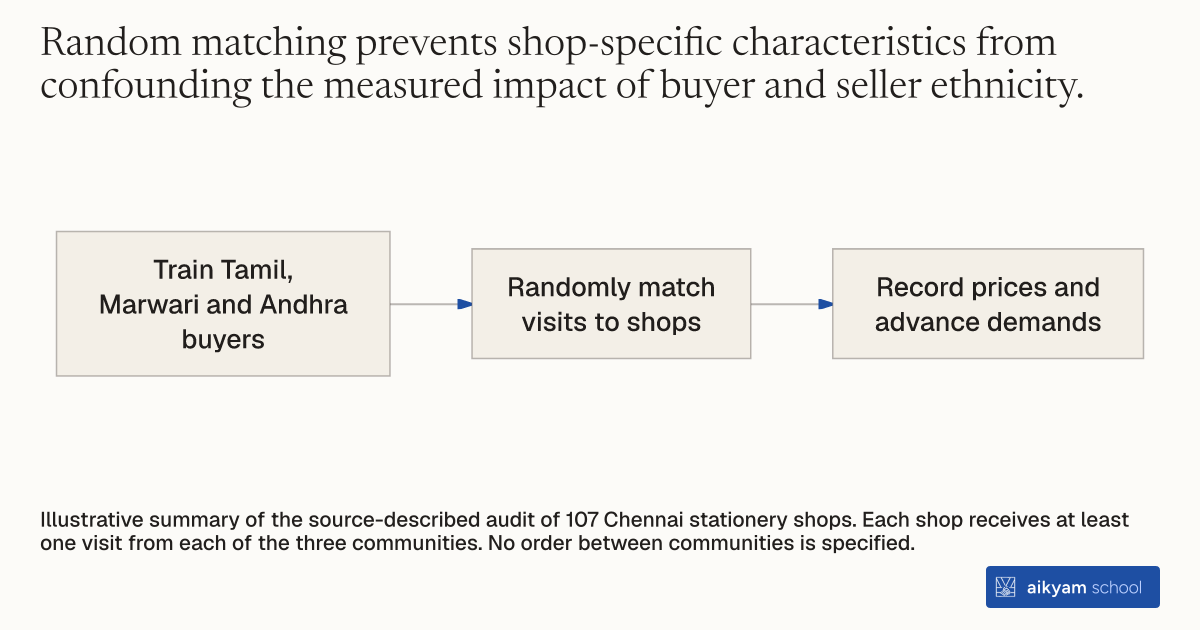
Research procedure
Audit transactions across communities
- Train Tamil, Marwari and Andhra buyers
- Randomly match visits to shops
- Record prices and advance demands
Illustrative summary of the source-described audit of 107 Chennai stationery shops. Each shop receives at least one visit from each of the three communities. No order between communities is specified.
See source →How
When to use
Market researchers need to measure price discrimination and bias in informal business transactions. Unobserved differences in buyer negotiation skills or credit risk often mask identity bias in observational data. This method helps researchers isolate identity bias by sending trained buyers from multiple identity groups to the same vendors.
Match trained auditors from different ethnic groups across wholesale vendors using a randomized schedule to measure transaction bias.
- Identify the target commercial sector and location, such as wholesale stationery markets in Chennai.
- Hire local entrepreneurs representing each major ethnic community in the region.
- Train auditors to pose as authentic business customers negotiating large product purchases.
- Assign auditors to wholesale shops using a randomized matching plan.
- Schedule visits so that every shop receives at least one visit from an auditor of each ethnic community.
- Record prices, advance payment demands, and negotiation outcomes immediately after each interaction.
Why it works
Cross-visitation enables researchers to separate seller baseline pricing from buyer-seller identity match effects.
Example
Researchers hired local entrepreneurs from Tamil, Marwari, and Andhra communities to pose as buyers at 107 wholesale pen and stationery stores in Chennai, India. Each store received auditor visits from all three ethnic groups to negotiate large pen purchases. Marwari wholesalers offered baseline prices 12 percent below average, Andhra wholesalers demanded 5 percent above average, and buyers received price discounts when matched with a seller of their own ethnicity.
About the study
Participants
107 pen and stationery stores in Chennai, India, owned by Tamilians, Marwaris, and Andhrites.
Study Design
Randomized audit experiment where hired auditors from Tamil, Marwari, and Andhra communities were randomly matched to wholesale stores so each shop was visited by auditors from all three communities.
Results
Matching buyer and seller ethnicity lowered prices, while Marwari sellers offered prices 12 percent below average and Andhra sellers charged 5 percent above average.