Research procedure
Compare requested advance payments
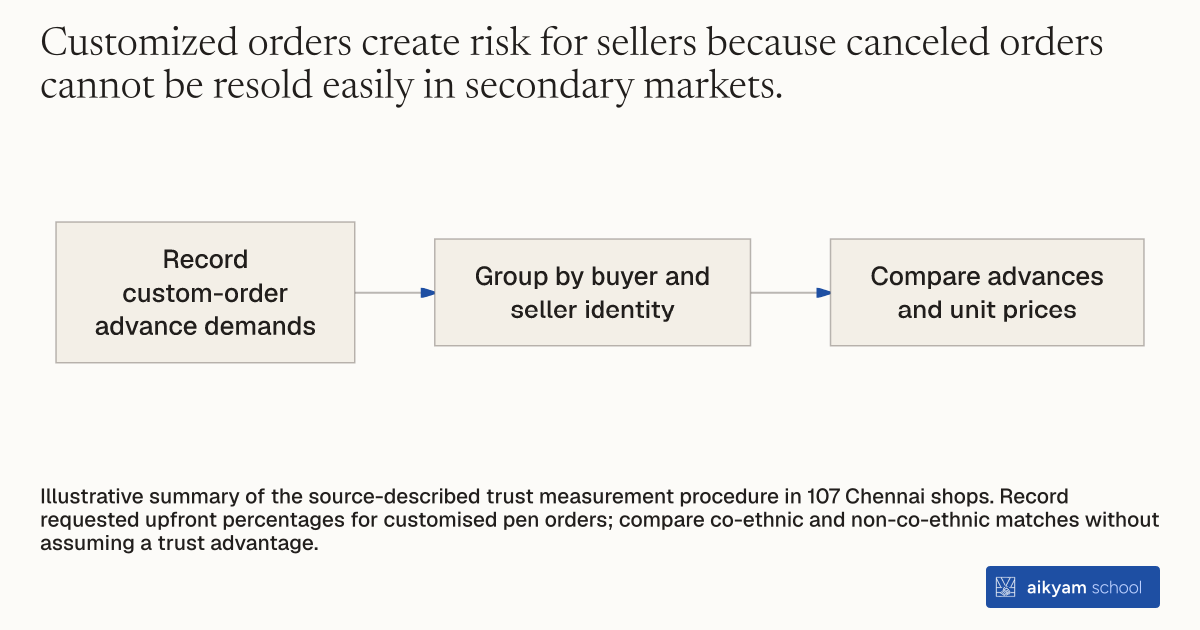
- Record custom-order advance demands
- Group by buyer and seller identity
- Compare advances and unit prices
Illustrative summary of the source-described trust measurement procedure in 107 Chennai shops. Record requested upfront percentages for customised pen orders; compare co-ethnic and non-co-ethnic matches without assuming a trust advantage.
See source →How
When to use
Market researchers and evaluators need an objective financial metric to evaluate counterparty trust and default risk in informal wholesale transactions. Relying on negotiated prices alone fails to isolate credit risk from personal bias or preference. Measuring required upfront advance payments provides a direct indicator of seller trust across buyer identity groups.
Measure required upfront advance payment percentages on customized orders to evaluate default risk and counterparty trust across commercial transactions.
- Identify transactions involving customized goods that carry high default risk due to limited secondhand resale value.
- Direct buyers during procurement negotiations to record the seller's initial requested advance payment percentage.
- Track requested advance payment percentages across different buyer and seller identity pairings.
- Calculate average advance payment demands for co-ethnic versus non-co-ethnic buyer matches.
- Compare upfront advance payment metrics against agreed unit prices to distinguish credit risk mitigation from price discounting.
Why it works
Requiring advance payments protects sellers against default loss, making the upfront payment requirement a pure measure of credit trust rather than personal preference.
Example
In Chennai, India, auditors posing as buyers visited 107 wholesale stationery shops to negotiate customized pen purchases. Wholesalers demanded advance payments on customized orders to manage default risk, but required identical upfront payments from co-ethnic buyers and non-co-ethnic buyers. Marwari and Andhra buyers were asked for higher advance payments than Tamilian buyers.
About the study
Participants
107 wholesale pen and stationery stores in Chennai, India, operated by Tamilians, Marwaris, and Andhrites.
Study Design
Randomized audit trial measuring requested advance payment percentages on logo-printed custom pen orders across co-ethnic and non-co-ethnic buyer-seller matches.
Results
Wholesalers did not ask for smaller upfront payments when matched with co-ethnic buyers, while Marwari and Andhra buyers faced higher advance payment demands than Tamil buyers.