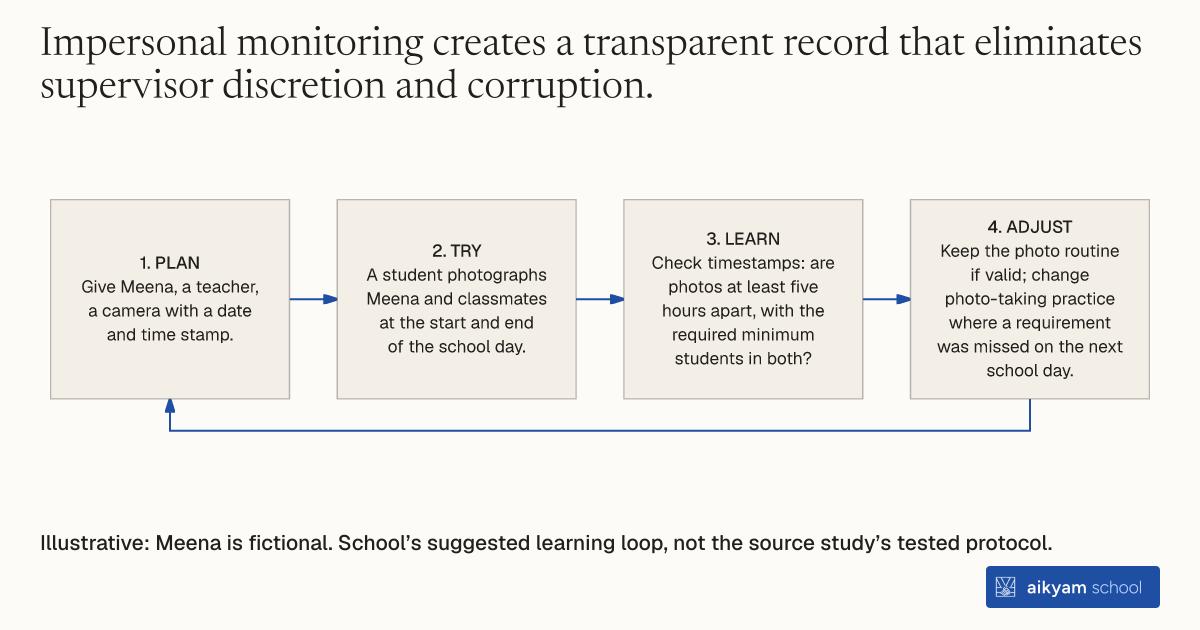
Try, learn and adjust
Check that daily attendance photos qualify
- Plan: Give Meena, a teacher, a camera with a date and time stamp.
- Try: A student photographs Meena and classmates at the start and end of the school day.
- Learn: Check timestamps: are photos at least five hours apart, with the required minimum students in both?
- Adjust: Keep the photo routine if valid; change photo-taking practice where a requirement was missed on the next school day.
Illustrative: Meena is fictional. School’s suggested learning loop, not the source study’s tested protocol.
See source →School’s suggested learning loop, not a tested protocol. Observe timestamps and required student presence in both photographs.
How
When to use
Rural single-teacher schools face severe teacher absenteeism because traditional supervisory monitoring rarely enforces presence. This lack of accountability reduces instructional time and harms learning outcomes for underserved students. Daily student-taken camera verification provides objective attendance records to ensure teachers show up and teach.
Use camera photography to verify daily teacher presence in classrooms.
- Give each teacher a camera equipped with a date and time stamp.
- Instruct a student to photograph the teacher and classmates at the start of the school day.
- Require a student to take a second photograph at the end of the school day.
- Ensure at least five hours separate the two daily photographs.
- Require a minimum number of students to be present in both photographs for the day to count.
Why it works
Teachers receive credible incentives and gain full control over their earnings by knowing attendance is measured objectively.
Example
Seva Mandir implemented camera attendance monitoring across single-teacher informal schools serving about 20 students each in rural Udaipur, India, raising teacher attendance from 58 percent to 79 percent.
About the study
Participants
Single-teacher informal schools in rural Udaipur, India, each teaching about 20 students in basic Hindi and math.
Study Design
Randomized controlled trial comparing single-teacher schools with camera monitoring against control schools using standard supervisor oversight, verified by unannounced random spot checks.
Results
Teacher attendance increased from 58 percent in the control group to 79 percent in the camera group, reducing absence from 42 percent to 21 percent and adding 34 instruction days per student annually.