Research steps
Combine children’s schooling and work measures
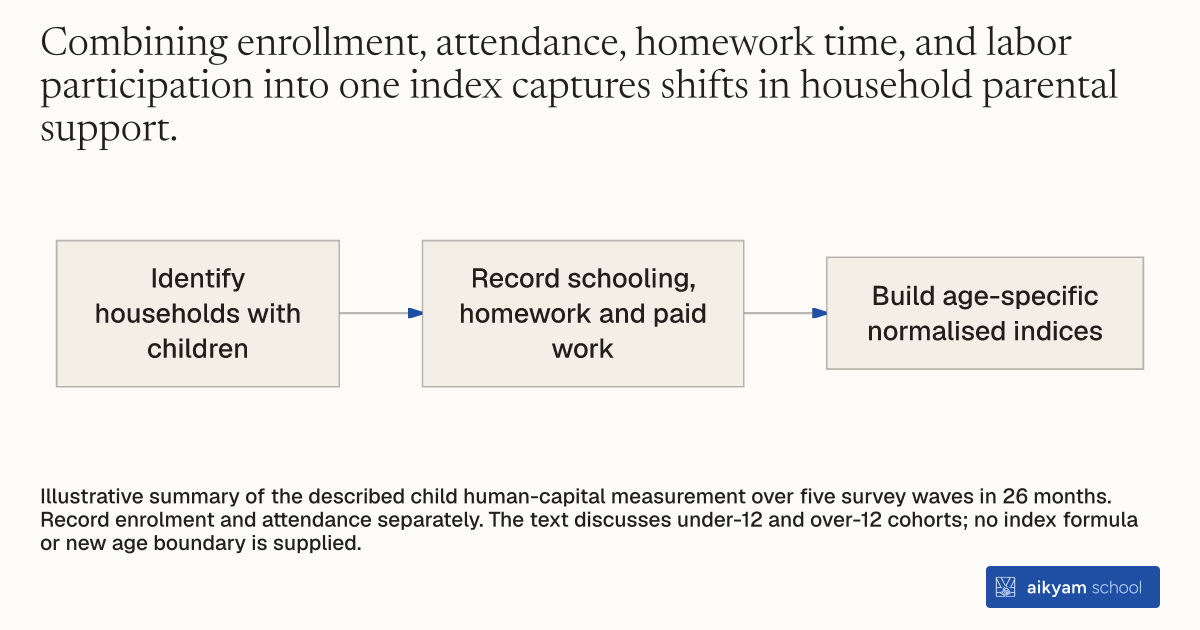
- Identify households with children
- Record schooling, homework and paid work
- Build age-specific normalised indices
Illustrative summary of the described child human-capital measurement over five survey waves in 26 months. Record enrolment and attendance separately. The text discusses under-12 and over-12 cohorts; no index formula or new age boundary is supplied.
See source →How
When to use
In low-income settings, adult depression reduces an individual's willingness to invest in their children. Assessing intergenerational spillovers requires structured measurement of children's schooling and labor activities. Constructing a composite index measures how adult depression interventions alter child human capital development.
Measure child educational engagement and labor participation using a composite index administered during household surveys.
- Surveyors identify households with children during adult depression trial evaluations.
- Enumerators collect child school enrollment and attendance data from household respondents.
- Field staff record the amount of time children spend completing homework.
- Enumerators document whether each child works for pay.
- Analysts synthesize schooling and labor metrics into a normalized human capital index for age-specific child cohorts.
Why it works
Analyzing age-differentiated groups reveals specific developmental windows where adult recovery yields intergenerational benefits.
Example
Researchers measured child human capital investment in households of 1,000 depressed adults across 506 villages near Bangalore, India, combining school enrollment, attendance, homework hours, and child labor indicators across survey waves over 26 months.
About the study
Participants
Households of 1,000 adults with mild or moderate depression (86 percent women) across 506 peri-urban villages near Bangalore, India.
Study Design
Four-arm randomized evaluation tracking child human capital investment indices across five survey waves over 26 months for children under twelve and older than twelve.
Results
Psychiatric care increased the human capital investment index by 0.44 standard deviations for children older than twelve post-program, whereas impacts on children under twelve were statistically insignificant.