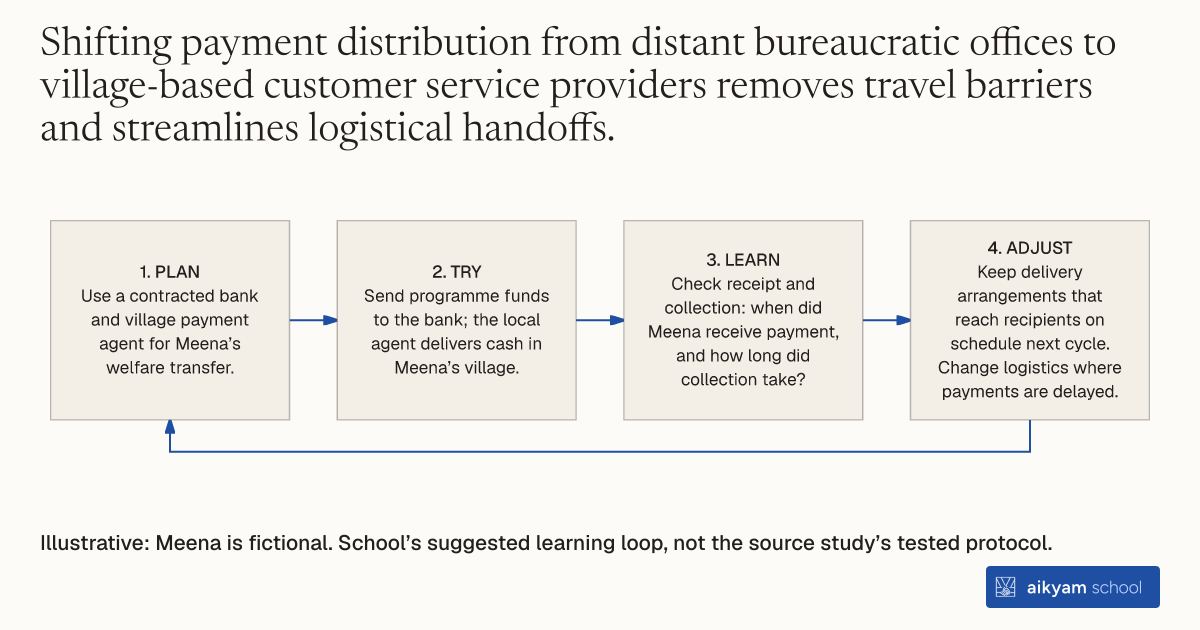
Try, learn and adjust
Check welfare cash reaches the village
- Plan: Use a contracted bank and village payment agent for Meena’s welfare transfer.
- Try: Send programme funds to the bank; the local agent delivers cash in Meena’s village.
- Learn: Check receipt and collection: when did Meena receive payment, and how long did collection take?
- Adjust: Keep delivery arrangements that reach recipients on schedule next cycle. Change logistics where payments are delayed.
Illustrative: Meena is fictional. School’s suggested learning loop, not the source study’s tested protocol.
See source →School’s suggested, untested loop. Observe receipt dates, payment delays and collection time; no delivery improvement is assumed.
How
When to use
Government social welfare programs often face long payment delays and high collection times when beneficiaries must travel to distant post offices or bank branches. Contracting local customer service providers in each village decentralizes fund distribution for rural program recipients. This allows beneficiaries to collect their cash payments directly within their own villages quickly and predictably.
Contract private banks and village-based agents to distribute public welfare funds locally to recipients.
- Government authorities contract private banks to manage social assistance payment logistics across designated rural districts.
- Contracting banks recruit and station a local Customer Service Provider in each target village.
- Government agencies transfer monthly social security pensions and weekly employment scheme funds directly to the contracted banks.
- Customer Service Providers receive cash allocations and travel directly to beneficiaries in their home villages.
- Village beneficiaries meet the local Customer Service Provider to collect cash transfers directly in their village.
Why it works
Contracting private banks and local agents reduces administrative bottlenecks and makes payment schedules faster and more reliable.
Example
In Andhra Pradesh, the state government contracted private banks and local Customer Service Providers to handle payment delivery for NREGS and SSP programs across 296 sub-districts. The organizational reform reduced payment collection time by 22 minutes for NREGS workers and shortened payment arrival delays by 6 to 10 days.
About the study
Participants
8,000 households in 8 districts of Andhra Pradesh, covering a rural population of nineteen million people.
Study Design
Cluster-randomized controlled trial across 296 sub-districts randomly assigned to early rollout (treatment) or delayed rollout (comparison) over two years.
Results
NREGS workers spent 22 fewer minutes collecting payments (a 20 percent decrease relative to 112 minutes in the comparison group) and received payments 6 to 10 days sooner, while the variation in payment delay length fell.