Try, learn and adjust
Check the daily workplace nap opportunity
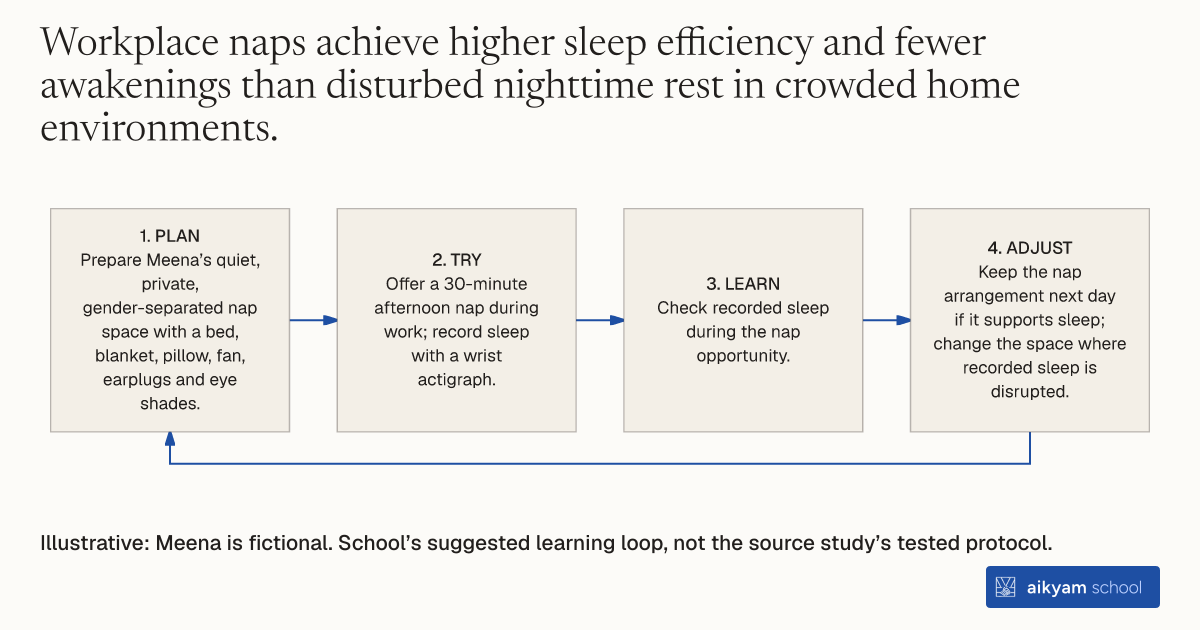
- Plan: Prepare Meena’s quiet, private, gender-separated nap space with a bed, blanket, pillow, fan, earplugs and eye shades.
- Try: Offer a 30-minute afternoon nap during work; record sleep with a wrist actigraph.
- Learn: Check recorded sleep during the nap opportunity.
- Adjust: Keep the nap arrangement next day if it supports sleep; change the space where recorded sleep is disrupted.
Illustrative: Meena is fictional. School’s suggested learning loop, not the source study’s tested protocol.
See source →School’s suggested learning loop: Observe nap sleep and sleep efficiency. This suggested loop is not the trial’s randomised comparison.
How
When to use
Low-income urban workers often suffer from poor nighttime sleep quality due to heat, crowding, and noise. Providing quiet workplace napping spaces enables workers to obtain high-quality restorative sleep during the workday. This method serves organizations and employers seeking to boost productivity, cognitive performance, and psychological well-being.
Establish quiet, private workplace resting rooms equipped with sleeping gear to provide daily nap opportunities for staff.
- Set up private, quiet, and gender-separated nap areas at the workplace.
- Furnish each nap space with a bed, blanket, pillow, table fan, earplugs, and eye shades.
- Schedule a daily half-hour afternoon nap period for participating employees during work hours.
- Track worker sleep states objectively using wrist actigraph monitors during the nap period.
Why it works
Afternoon naps reduce fatigue and restore attention, directly improving cognitive function and work output.
Example
Researchers provided a randomized subset of 452 low-income data entry workers in Chennai, India, with daily half-hour naps in private, equipped workplace spaces over a one-month period.
About the study
Participants
A subset of 452 low-income men and women in Chennai, India, with an average of 10 years of education.
Study Design
A randomized trial evaluating daily 30-minute workplace afternoon naps in equipped gender-separated spaces against non-napping and work-break controls.
Results
Office naps reached 85 percent sleep quality compared to 66 percent for night sleep, increased worker productivity by 2.3 percent, and raised daily earnings by 4.1 percent or INR 11 (about US\$0.05).