Try, learn and adjust
Check sleep-linked daily payments
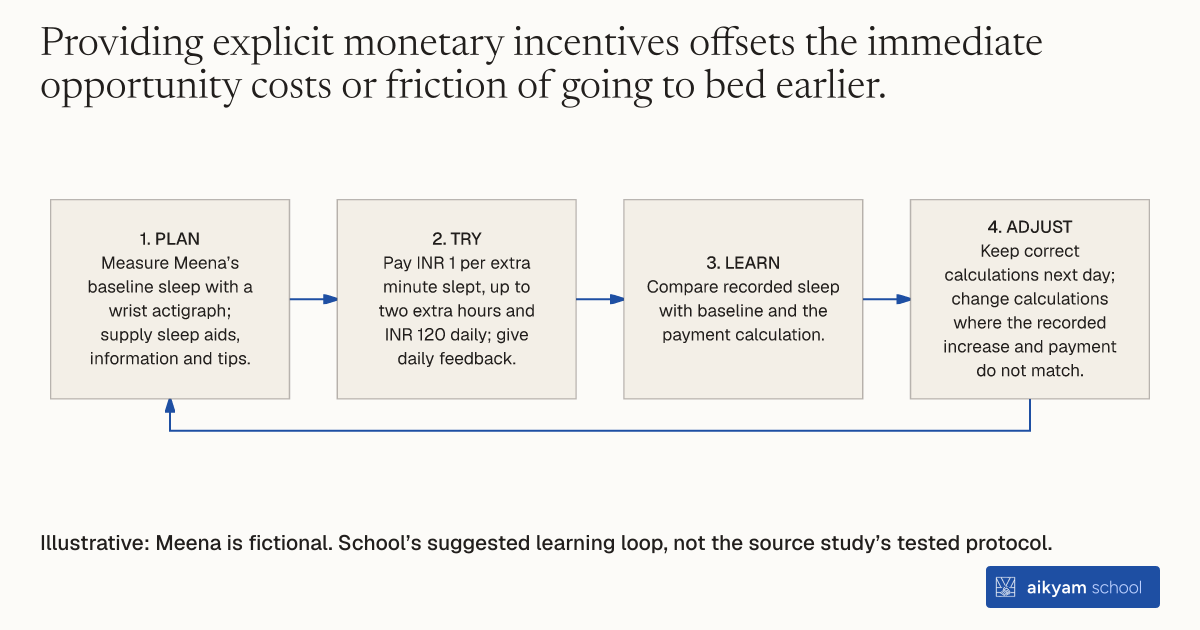
- Plan: Measure Meena’s baseline sleep with a wrist actigraph; supply sleep aids, information and tips.
- Try: Pay INR 1 per extra minute slept, up to two extra hours and INR 120 daily; give daily feedback.
- Learn: Compare recorded sleep with baseline and the payment calculation.
- Adjust: Keep correct calculations next day; change calculations where the recorded increase and payment do not match.
Illustrative: Meena is fictional. School’s suggested learning loop, not the source study’s tested protocol.
See source →School’s suggested learning loop: Observe measured sleep, baseline comparison and daily payment limits. The trial found no detectable cognition or well-being benefit.
How
When to use
Low-income urban workers frequently face severe sleep deprivation due to ambient noise, heat, and physical discomfort. Offering direct cash payments per minute of increased sleep helps motivate individuals to allocate more time in bed at night. This method targets low-income individuals whose sleep duration remains far below recommended health guidelines.
Offer daily financial rewards calculated per minute of added nighttime sleep to encourage low-income adults to spend more time in bed.
- Establish each participant's baseline sleep duration using objective wrist actigraphy before starting incentives.
- Provide participants with sleep environment devices, information on sleep health benefits, and actionable sleep tips.
- Pay participants INR 1 per minute of increased nighttime sleep relative to baseline for up to two hours per night.
- Issue daily incentive payments of up to INR 120 (about US\$1.70) based on continuous actigraph measurements.
- Provide daily feedback on measured sleep duration to track progress toward the incentive maximum.
Why it works
Direct financial rewards encourage individuals to adjust their schedules and stay in bed longer despite environmental barriers.
Example
Researchers offered 452 low-income urban workers in Chennai, India, INR 1 per minute of additional sleep (up to INR 120 or US\$1.70 daily) alongside sleep environment improvements and guidance.
About the study
Participants
452 men and women from low-income neighborhoods in Chennai, India, with an average of 10 years of education and 1 to 2 children.
Study Design
A randomized evaluation comparing participants receiving home devices, tips, and financial incentives against control groups over a one-month study period.
Results
The intervention increased nighttime sleep by an average of 27 minutes per night by inducing 38 additional minutes spent in bed, but led to small decreases in labor supply and earnings with no detectable impacts on cognition or well-being.