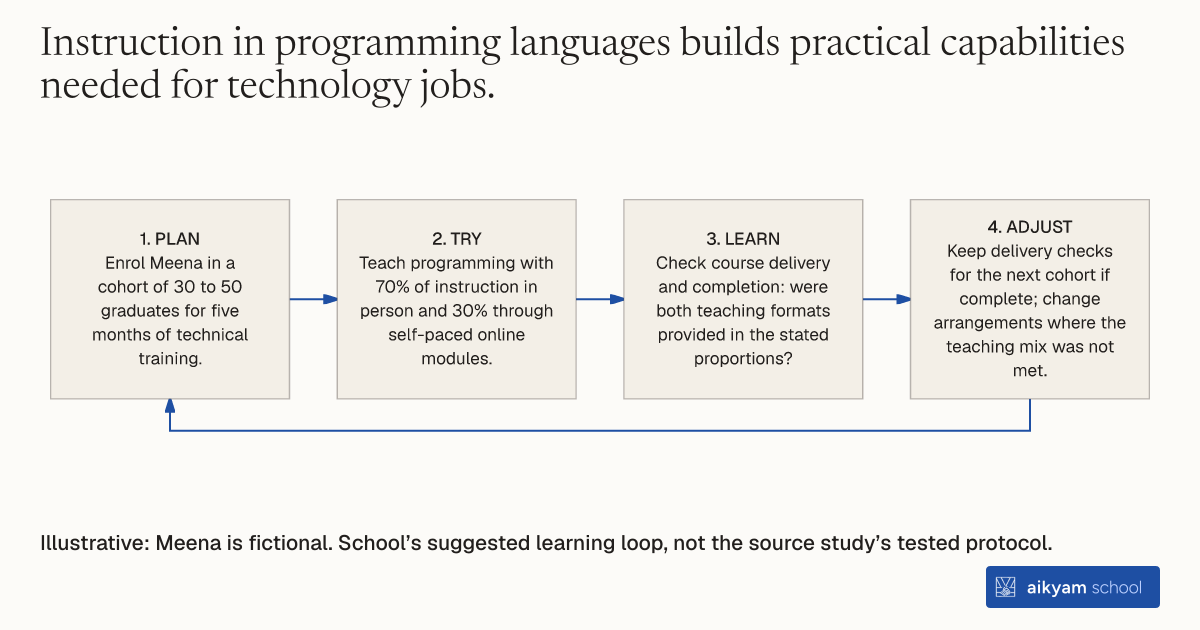
Try, learn and adjust
Check the DeepTech teaching mix
- Plan: Enrol Meena in a cohort of 30 to 50 graduates for five months of technical training.
- Try: Teach programming with 70% of instruction in person and 30% through self-paced online modules.
- Learn: Check course delivery and completion: were both teaching formats provided in the stated proportions?
- Adjust: Keep delivery checks for the next cohort if complete; change arrangements where the teaching mix was not met.
Illustrative: Meena is fictional. School’s suggested learning loop, not the source study’s tested protocol.
See source →School’s suggested, untested learning loop. Observe instruction format and completion; experimental employment results are ongoing, not established.
How
When to use
Graduates from lower tier colleges often struggle to secure technology jobs due to skill gaps. Training providers need to build technical qualifications required by private sector employers. Deliver structured instruction in technical subjects to prepare job seekers for technical roles.
Deliver a five-month job training program combining classroom instruction and self-paced online learning.
- Enroll cohorts of 30 to 50 students per class.
- Deliver 70 percent of course instruction in person.
- Assign 30 percent of course instruction through self-paced online modules.
- Teach technical skills including programming languages over the five-month duration.
Why it works
Combining interactive classroom learning with online modules allows flexible skill acquisition.
Example
NGO Anudip enrolled 2,333 college graduates in urban Delhi and Maharashtra into the five-month DeepTech training program.
About the study
Participants
2,333 college graduates (1,633 men and 700 women) with engineering or computer science degrees in urban Delhi and Maharashtra, India.
Study Design
Randomized controlled trial comparing graduates offered the five-month DeepTech program against a comparison group of 1,000 graduates.
Results
Anudip historical data indicates 50 to 70 percent of trained students secured STEM jobs; experimental evaluation results are ongoing.