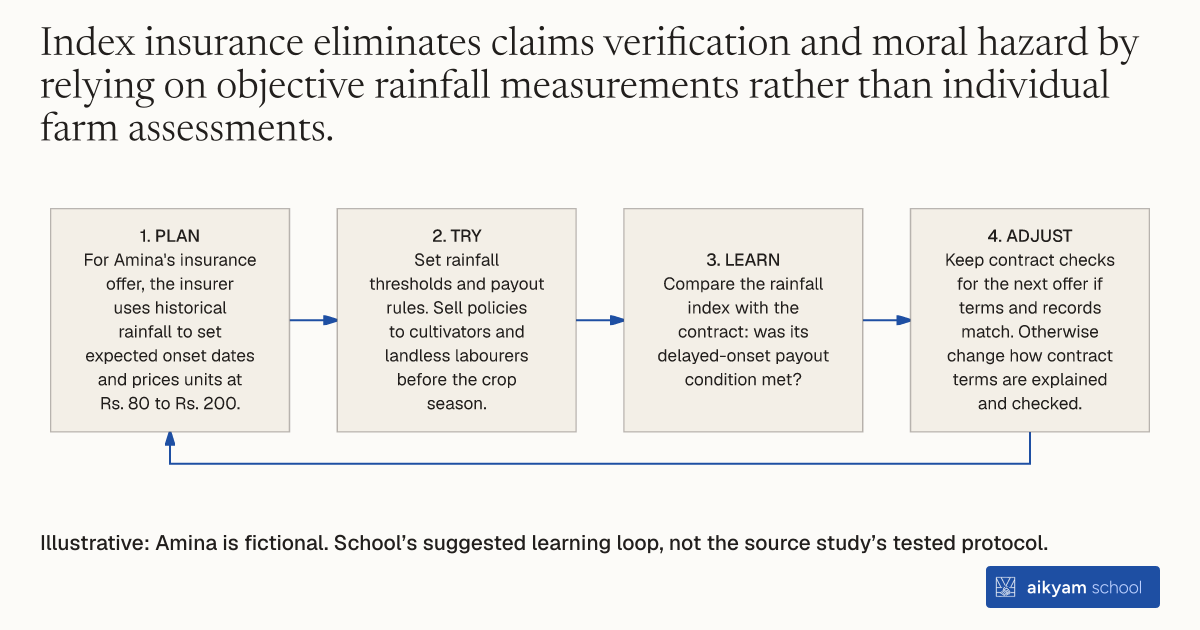
Try, learn and adjust
Check rainfall insurance follows the stated trigger
- Plan: For Amina's insurance offer, the insurer uses historical rainfall to set expected onset dates and prices units at Rs. 80 to Rs. 200.
- Try: Set rainfall thresholds and payout rules. Sell policies to cultivators and landless labourers before the crop season.
- Learn: Compare the rainfall index with the contract: was its delayed-onset payout condition met?
- Adjust: Keep contract checks for the next offer if terms and records match. Otherwise change how contract terms are explained and checked.
Illustrative: Amina is fictional. School’s suggested learning loop, not the source study’s tested protocol.
See source →School's suggested, untested loop: observe policy terms, rainfall thresholds and payout conditions; no payout or income protection is assumed.
How
When to use
Smallholder farmers and landless laborers face severe income loss when annual monsoon rains arrive late. Standard crop loss insurance suffers from high administration costs and moral hazard. Designing an index insurance contract based on delayed monsoon onset provides automated cash payouts during critical sowing periods without individual loss verification.
Structure and issue an index rainfall insurance policy that triggers cash payouts when monsoon rains fall behind historical onset dates.
- Partner with a commercial or state agricultural insurance provider to structure the index contract.
- Calculate baseline expected monsoon onset dates across target rural districts using historical weather records.
- Price insurance contract units between Rs. 80 and Rs. 200 based on actuarial district risk.
- Establish automated contract payout rules triggered when seasonal rainfall fails to cross thresholds by the baseline onset date.
- Market and sell policy units directly to cultivating farmers and landless agricultural wage laborers prior to the crop season.
Why it works
Triggering payouts on delayed monsoon onset injects liquidity precisely when farmers need capital to adjust planting strategies or cushion income shocks.
Example
Researchers collaborated with Agricultural Insurance Company of India Lombard to offer delayed monsoon onset contracts priced between Rs. 80 and Rs. 200 across 42 Indian villages, achieving a 40 percent overall purchase rate among sample households.
About the study
Participants
4,667 households (cultivators and landless agricultural laborers) across 63 rural Indian villages.
Study Design
Randomized controlled trial offering AICI delayed monsoon onset insurance contracts across 42 treatment villages at varying randomized discount tiers.
Results
Roughly 40 percent of households purchased the delayed monsoon contract, with less than a 4 percentage point difference in take-up rates between agricultural laborers and land-cultivating farmers.