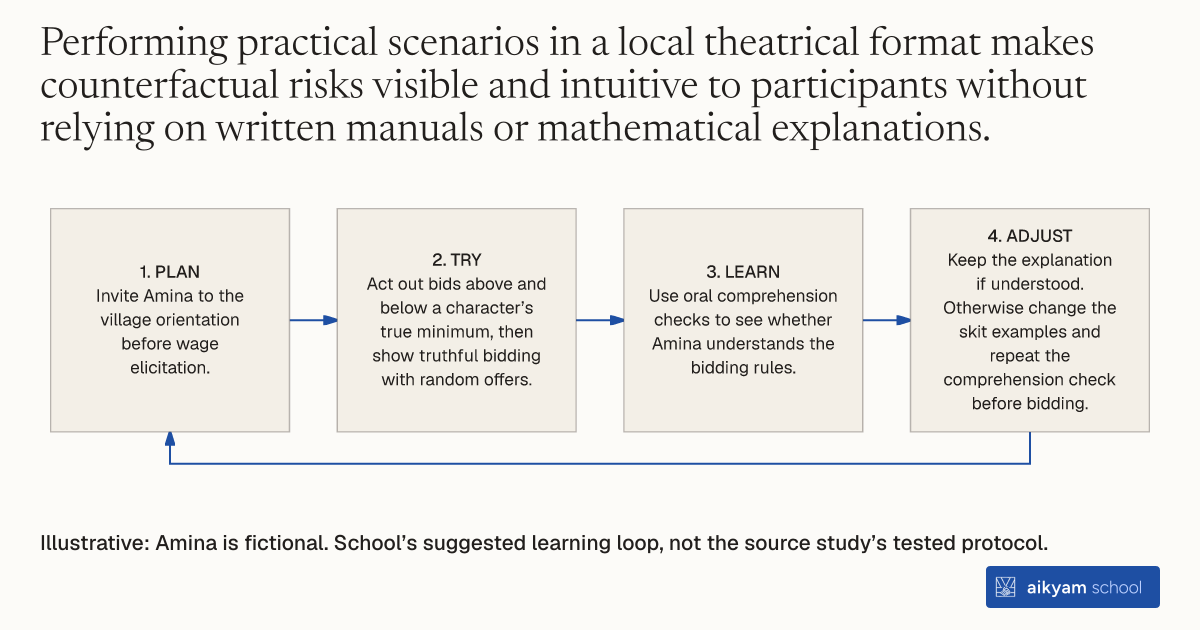
Try, learn and adjust
Check understanding of random wage offers
- Plan: Invite Amina to the village orientation before wage elicitation.
- Try: Act out bids above and below a character’s true minimum, then show truthful bidding with random offers.
- Learn: Use oral comprehension checks to see whether Amina understands the bidding rules.
- Adjust: Keep the explanation if understood. Otherwise change the skit examples and repeat the comprehension check before bidding.
Illustrative: Amina is fictional. School’s suggested learning loop, not the source study’s tested protocol.
See source →School’s suggested learning loop, not the source’s tested procedure. Observe answers to comprehension checks. Later refusal rates do not isolate the skit’s causal effect.
How
When to use
When implementing complex economic mechanisms like the Becker-DeGroot-Marschak exercise in rural communities, participants may struggle to grasp abstract incentive structures. Misunderstanding the rules can lead workers to strategic misreporting, underbidding, or distrusting the random pay draw. Live dramatic skits make abstract auction logic clear to participants before formal wage elicitation begins.
Educate research participants on mechanism rules by staging live theatrical skits during community orientation sessions.
- Gather interested community members at a central village location for an afternoon orientation and training session.
- Have field surveyors perform a live skit acting out real-life bidding scenarios and drawing random wage offers.
- Walk participants through examples where a character bids higher than their true minimum wage and loses out on a profitable contract.
- Stage examples showing a character who bids below their true minimum wage and ends up winning an unprofitable contract.
- Demonstrate that stating one's exact minimum acceptable wage guarantees working whenever the random pay offer is acceptable.
- Conduct oral comprehension checks after the skit to verify that each participant understands truthful bidding as their best strategy.
Why it works
Visualizing how strategic misreporting fails reinforces truthful wage revelation as the dominant individual strategy.
Example
Field researchers performed orientation skits across 12 villages in rural Malawi during Monday afternoon training sessions prior to four days of casual bean-sorting contracts. Out of 689 participants, fewer than 3 percent rejected drawn contracts that matched their stated bids, and ex-post dissatisfaction dropped from 23.3 percent on day one to 7.2 percent on day four as workers understood the mechanism.
About the study
Participants
689 participants (66.5% female, average age 34.9 years) across 1,875 daily decisions in 12 villages in rural Malawi.
Study Design
Pre-experiment orientation skits explaining BDM incentive compatibility followed by four consecutive days of individual wage elicitation and casual labor output tracking.
Results
Ex-post contract refusal was under 3 percent (0.026 overall), and stating ex-post willingness to accept a previously rejected draw fell from 23.3 percent on Day 1 to 7.2 percent on Day 4 (p < 0.01).