Research valuation
Compare a binding bid with a random price
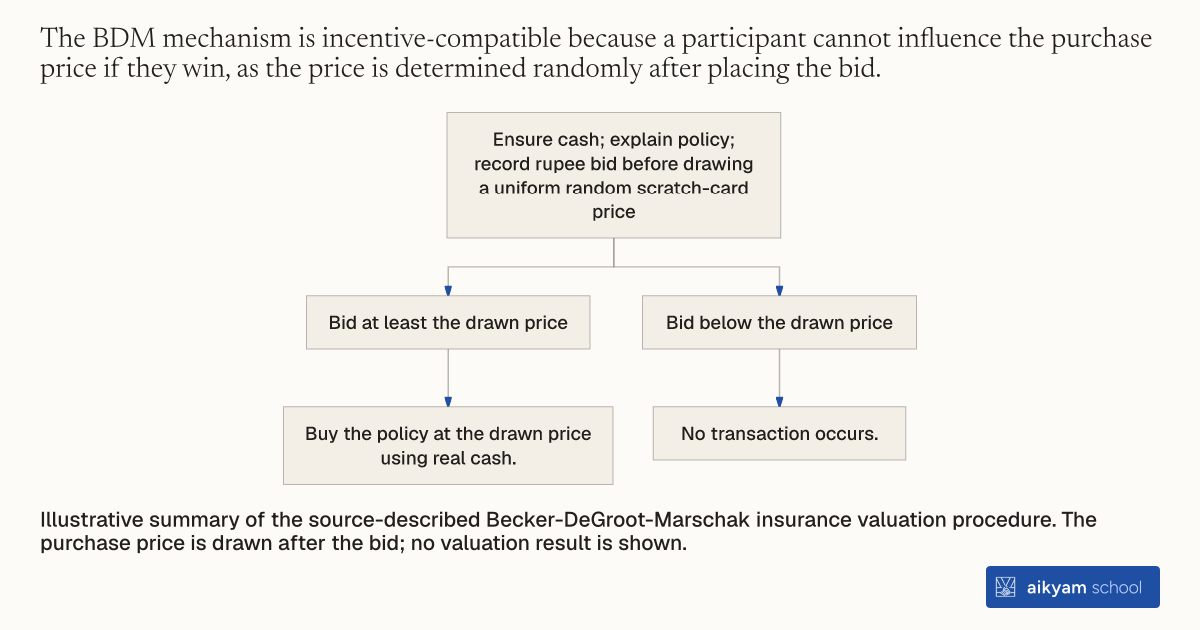
Ensure cash; explain policy; record rupee bid before drawing a uniform random scratch-card price
- Bid at least the drawn price
- Buy the policy at the drawn price using real cash.
- Bid below the drawn price
- No transaction occurs.
Illustrative summary of the source-described Becker-DeGroot-Marschak insurance valuation procedure. The purchase price is drawn after the bid; no valuation result is shown.
See source →How
When to use
An evaluation team needs to measure true consumer willingness-to-pay for financial contracts without subjects understating or overstating their valuation. Hypothetical survey questions produce hypothetical bias where respondents state inflated valuations they would not pay with real money. Field staff execute an incentive-compatible Becker-DeGroot-Marschak bidding mechanism with real cash transactions to elicit true willingness-to-pay.
Elicit real monetary willingness-to-pay for insurance products using an incentive-compatible Becker-DeGroot-Marschak pricing mechanism during household visits.
- Provide subjects with a real cash endowment or ensure they hold cash to make binding purchases.
- Present the detailed parameters of an ICICI Lombard rainfall index insurance policy to the participant.
- Require the participant to state their maximum willingness-to-pay bid in rupees for the policy.
- Draw a random offer price from a uniform distribution covered under a scratch card.
- Compare the stated bid against the drawn offer price in front of the subject: if the bid is at least as high as the offer price, the subject buys the policy at the drawn price using their cash; if the bid is lower, no transaction occurs.
Why it works
Stating a bid higher than true valuation risks paying more than the policy is worth, while bidding below true valuation risks missing out on a beneficial purchase.
Example
Enumerators conducted the BDM mechanism with 1,978 smallholder farmers across villages in Mahbubnagar and Anantapur, Andhra Pradesh, India, between May and August 2010. Farmers stated bids for real ICICI Lombard rainfall insurance policies with an expected payout of Rs. 44 to 54 and a retail price of Rs. 100 to 110. The average bid was Rs. 68.40 and the median bid was Rs. 70.00, demonstrating real commercial demand above actuarial costs.
About the study
Participants
1,978 smallholder farmers (1,464 existing trial participants and 514 new subjects) across rural villages in Mahbubnagar and Anantapur, Andhra Pradesh, India.
Study Design
Incentive-compatible field experiment using the Becker-DeGroot-Marschak mechanism with real cash transactions to elicit binding willingness-to-pay bids across 4 insurance policy variations.
Results
The mean willingness-to-pay for the baseline policy was Rs. 68.40 and the median was Rs. 70.00, compared to an actuarial expected payout of Rs. 44 to 54 and retail price of Rs. 100 to 110.