Research procedure
Practise bidding before insurance valuation
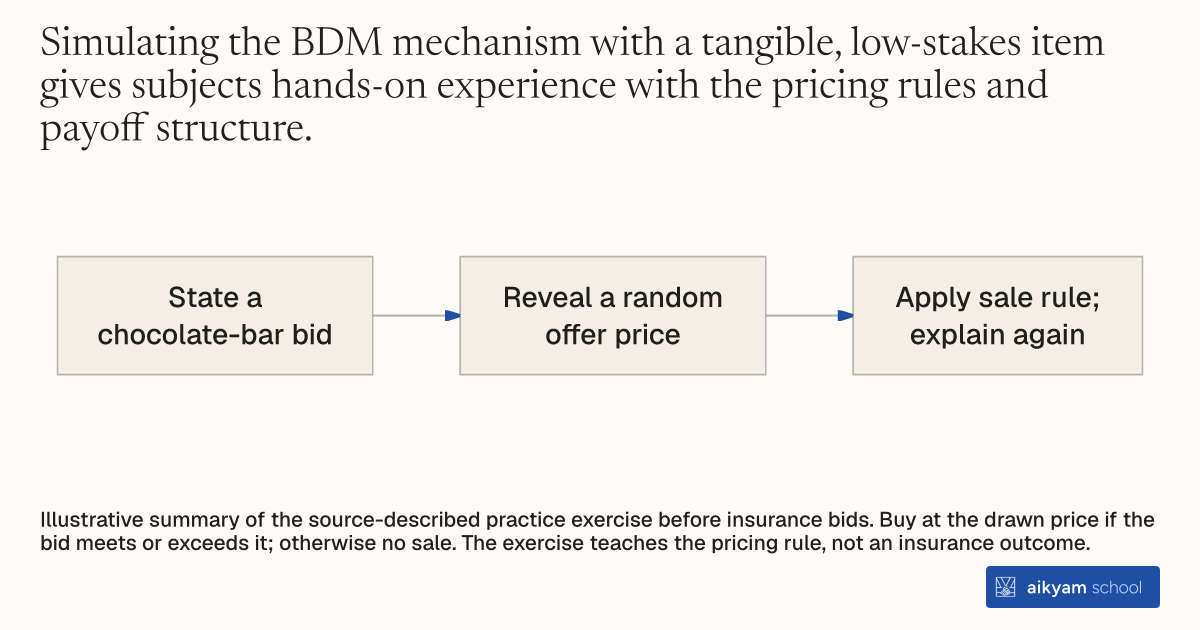
- State a chocolate-bar bid
- Reveal a random offer price
- Apply sale rule; explain again
Illustrative summary of the source-described practice exercise before insurance bids. Buy at the drawn price if the bid meets or exceeds it; otherwise no sale. The exercise teaches the pricing rule, not an insurance outcome.
See source →How
When to use
Field enumerators elicit real economic valuations using complex incentive-compatible mechanisms like the Becker-DeGroot-Marschak procedure. Unfamiliar respondents in rural areas can misunderstand bidding rules or strategic incentives, distorting elicited price data. Field staff conduct an initial practice bidding round using an everyday familiar item like a chocolate bar so participants learn how true-valuation bidding operates before evaluating real financial products.
Train experimental subjects on the Becker-DeGroot-Marschak mechanism by conducting a practice valuation game with a chocolate bar prior to real financial contract elicitations.
- Visit households in person during pre-monsoon survey visits and explain the basic concept of incentive-compatible pricing.
- Present a physical chocolate bar to the participant as a tangible, familiar practice item.
- Instruct the participant to state and record their maximum real willingness-to-pay bid in rupees for the chocolate bar.
- Draw a random offer price from a uniform distribution pre-printed under a scratch-card surface.
- Compare the participant's stated bid against the drawn offer price in front of the subject to demonstrate the rule: if the bid equals or exceeds the offer price, the subject buys the chocolate bar at the lower drawn price, otherwise no sale occurs.
- Re-explain that bidding above or below one's true personal valuation leads to overpaying or missing out on a profitable trade, establishing complete comprehension of the mechanism.
Why it works
Experiencing how bids interact with randomly generated offer prices eliminates strategic misreporting and prepares respondents to state their true willingness-to-pay accurately.
Example
Interviewers visited 1,978 farming households across villages in Andhra Pradesh, India, between May and August 2010. To ensure understanding of the complex BDM procedure before bidding on four distinct ICICI Lombard rainfall insurance policies, enumerators had each respondent simulate an initial round by bidding for a chocolate bar.
About the study
Participants
1,978 smallholder farmers (1,464 existing trial participants and 514 new subjects) across rural villages in Mahbubnagar and Anantapur, Andhra Pradesh, India.
Study Design
Incentive-compatible field experiment utilizing an initial practice BDM chocolate bar simulation followed by real monetary willingness-to-pay bidding on four randomized insurance policy structures.
Results
Across 1,978 trained participants, 0 recorded instances occurred where subjects reneged on transactions or refused to purchase insurance policies when the randomly drawn offer price fell below their stated willingness to pay.