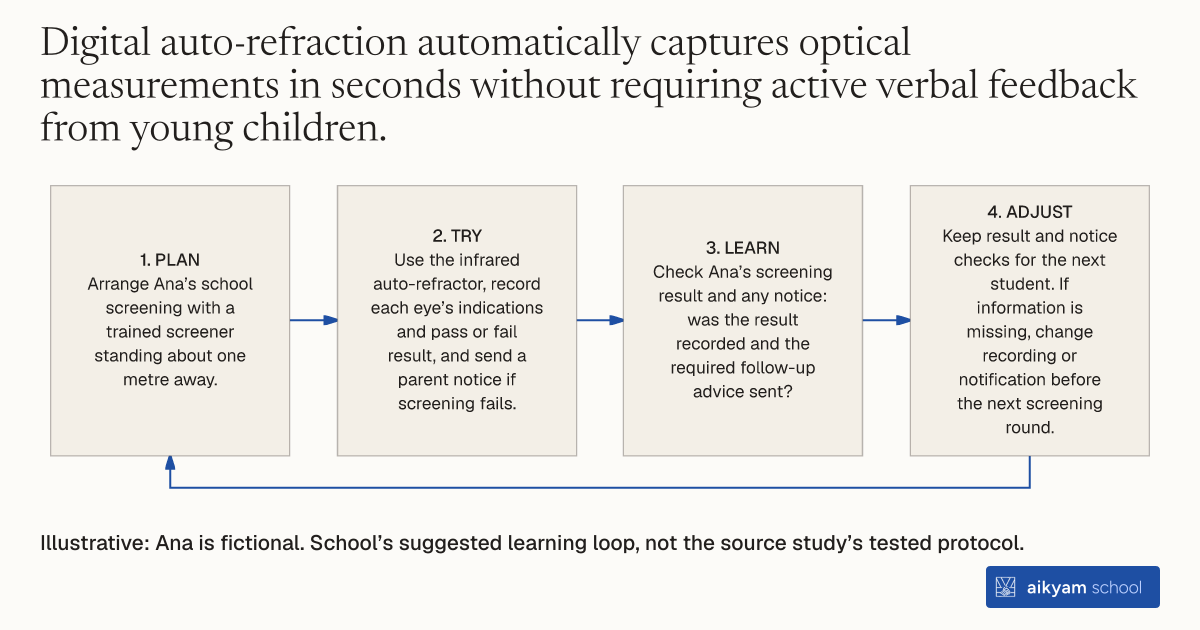
Try, learn and adjust
Check screening results and follow-up notices
- Plan: Arrange Ana’s school screening with a trained screener standing about one metre away.
- Try: Use the infrared auto-refractor, record each eye’s indications and pass or fail result, and send a parent notice if screening fails.
- Learn: Check Ana’s screening result and any notice: was the result recorded and the required follow-up advice sent?
- Adjust: Keep result and notice checks for the next student. If information is missing, change recording or notification before the next screening round.
Illustrative: Ana is fictional. School’s suggested learning loop, not the source study’s tested protocol.
See source →School’s suggested learning loop, not a source-tested procedure. Observe recorded screening results and written follow-up notices. This loop does not change clinical decisions or establish learning gains.
How
When to use
Low-income elementary school students face high rates of undetected vision problems that impair learning. Standard eye charts miss many refractive errors and pupil abnormalities in young children. Rapid digital photoscreening detects refractive errors quickly without requiring active child responses.
Screen elementary school students for visual refractive errors using a handheld digital auto-refractor device.
- Station a trained screener about one meter away from each student in target elementary school classrooms.
- Capture a digital photograph of the student's eyes using an infrared camera equipped with auto-refraction technology.
- Allow the automated system to process refractive errors, amblyopic precursors, and pupil abnormalities immediately.
- Record the automated pass or fail screening result alongside diagnostic indications for each eye.
- Send written notices to parents of students who fail the screening to advise follow-up care with an eye doctor.
Why it works
This identifies vision impairments missed by standard eye charts and ensures timely detection during crucial developmental years.
Example
A non-profit screened 5,747 fourth and fifth grade students across Title 1 elementary schools in three central Florida school districts using the Spot auto-refractor device. The screening identified 1,760 students who failed, revealing a 31% overall failure rate for untreated vision issues.
About the study
Participants
5,747 fourth and fifth grade students in Title 1 elementary schools across three central Florida school districts, where over 70% of students qualified for free or reduced-price lunch.
Study Design
School-level randomized controlled trial comparing screen-only schools, full-treatment schools, and control schools across 115 Title 1 elementary schools.
Results
Enhanced screening alone identified a 31% failure rate among screened students, but screening without follow-up care resulted in no significant test score gains compared to control schools.