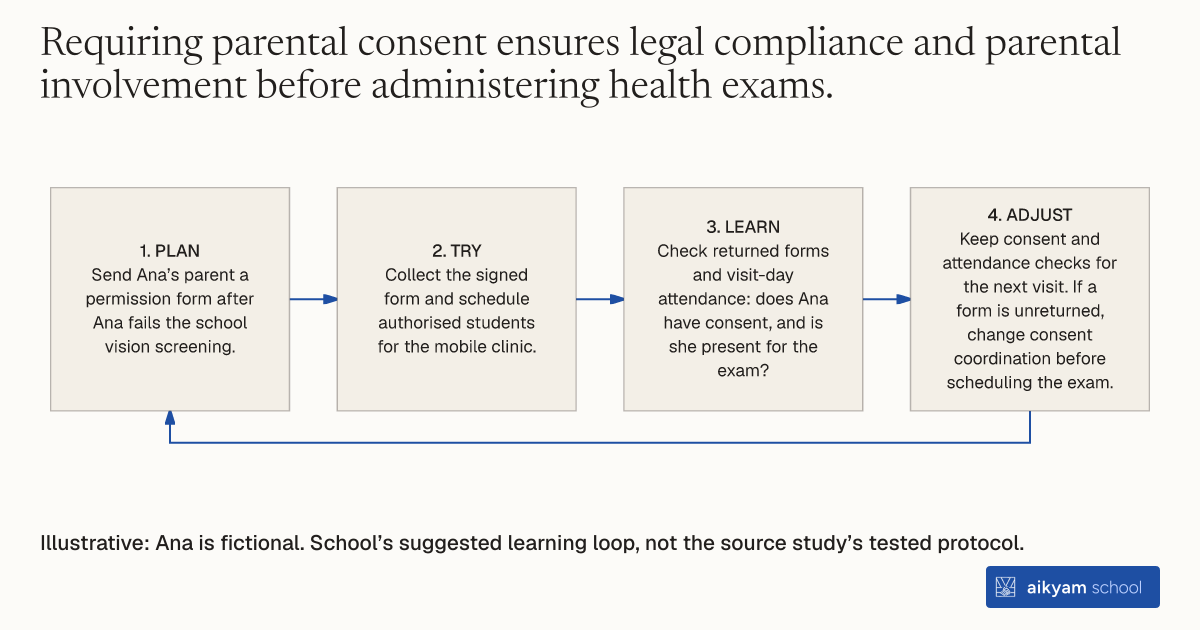
Try, learn and adjust
Check consent before the mobile clinic visit
- Plan: Send Ana’s parent a permission form after Ana fails the school vision screening.
- Try: Collect the signed form and schedule authorised students for the mobile clinic.
- Learn: Check returned forms and visit-day attendance: does Ana have consent, and is she present for the exam?
- Adjust: Keep consent and attendance checks for the next visit. If a form is unreturned, change consent coordination before scheduling the exam.
Illustrative: Ana is fictional. School’s suggested learning loop, not the source study’s tested protocol.
See source →School’s suggested learning loop, not a source-tested procedure. Observe returned permission forms and student presence. In the source, both unreturned forms and absence prevented some exams.
How
When to use
Providing on-site mobile vision exams to elementary school students requires affirmative parental permission. Students who fail vision screenings cannot receive diagnostic exams or free prescription eyeglasses without completed consent forms returned to the school. Systematic permission slip collection engages parents and enables eligible children to access mobile health care services.
Collect completed parent permission forms at elementary schools to authorize student participation in on-site mobile vision examinations.
- Distribute parent permission forms home with students who fail digital auto-refraction vision screenings at school.
- Require parents to sign and return the completed permission slip to authorize on-site mobile clinic exams.
- Track returned permission slips at the school before the mobile clinic's scheduled visit dates.
- Schedule students with returned permission slips for comprehensive examinations aboard the mobile vision clinic.
Why it works
Establishing clear return mechanisms allows non-profit providers to identify authorized students prior to mobile clinic deployments.
Example
In full-treatment Title 1 elementary schools across three central Florida districts, 914 out of 1,222 students who failed vision screening submitted signed parent permission forms and received mobile clinic exams, achieving a 75% examination compliance rate.
About the study
Participants
1,222 fourth and fifth grade students in Title 1 elementary schools across three central Florida districts who failed vision screenings.
Study Design
School-level randomized controlled trial evaluating full-treatment schools where parent permission forms were collected to deliver mobile clinic exams and free eyeglasses.
Results
Collecting signed parent permission forms enabled 75% (914 out of 1,222) of screening-failed students to be examined, but unreturned forms and student absences prevented 25% of eligible children from receiving mobile health services.