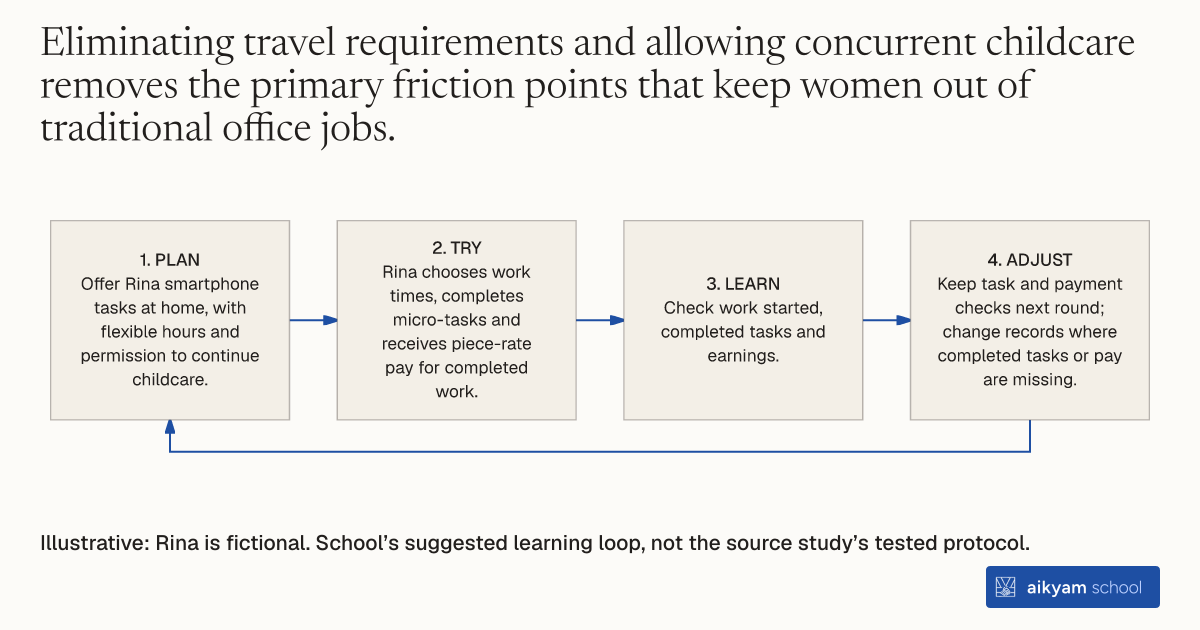
Try, learn and adjust
Check flexible home work and completed-task pay
- Plan: Offer Rina smartphone tasks at home, with flexible hours and permission to continue childcare.
- Try: Rina chooses work times, completes micro-tasks and receives piece-rate pay for completed work.
- Learn: Check work started, completed tasks and earnings.
- Adjust: Keep task and payment checks next round; change records where completed tasks or pay are missing.
Illustrative: Rina is fictional. School’s suggested learning loop, not the source study’s tested protocol.
See source →School’s suggested learning loop; not a tested source procedure. Observe take-up and paid task completion. This loop does not establish productivity or childcare effects.
How
When to use
Many adult women remain outside the paid labor force because existing employment opportunities conflict with domestic responsibilities. Flexible home-based gig work addresses this barrier by allowing women to earn income while managing childcare duties. This approach serves caregivers facing tight home time constraints or restrictive local mobility norms.
Offer gig job arrangements that permit workers to work from home at flexible hours while continuing childcare multitasking.
- Program managers design smartphone micro-task jobs that require no travel to a central office location.
- Recruiters offer eligible women home-based gig work options with explicit permission to multitask with childcare.
- Workers choose their working hours dynamically throughout the day based on household availability.
- Workers perform assigned micro-tasks on personal smartphones while remaining present at home with dependents.
- Program administrators measure worker take-up rates and compensate completed work at piece-rate wages.
Why it works
Women can earn income without compromising traditional household role expectations.
Example
In Kolkata, West Bengal, India, researchers offered 208 women flexible home-based gig work with childcare multitasking, resulting in a 33 percentage point higher take-up rate compared to office work options where only 14.6 percent of women started work.
About the study
Participants
208 women assigned to the flexible plus childcare group (part of 1,670 total women; average age 30, 93% married, 48% caring for young children) in Kolkata, West Bengal, India.
Study Design
Randomized controlled trial comparing six distinct work arrangement groups (flexible with/without childcare, fixed timeslot with/without childcare, office work, and comparison group) across two four-week rounds.
Results
Women given the flexible home-based offer with childcare multitasking were 33 percentage points (228%) more likely to start work than those offered office jobs, while office job take-up was only 14.6 percent.