Try, learn and adjust
Check receipt of official health texts
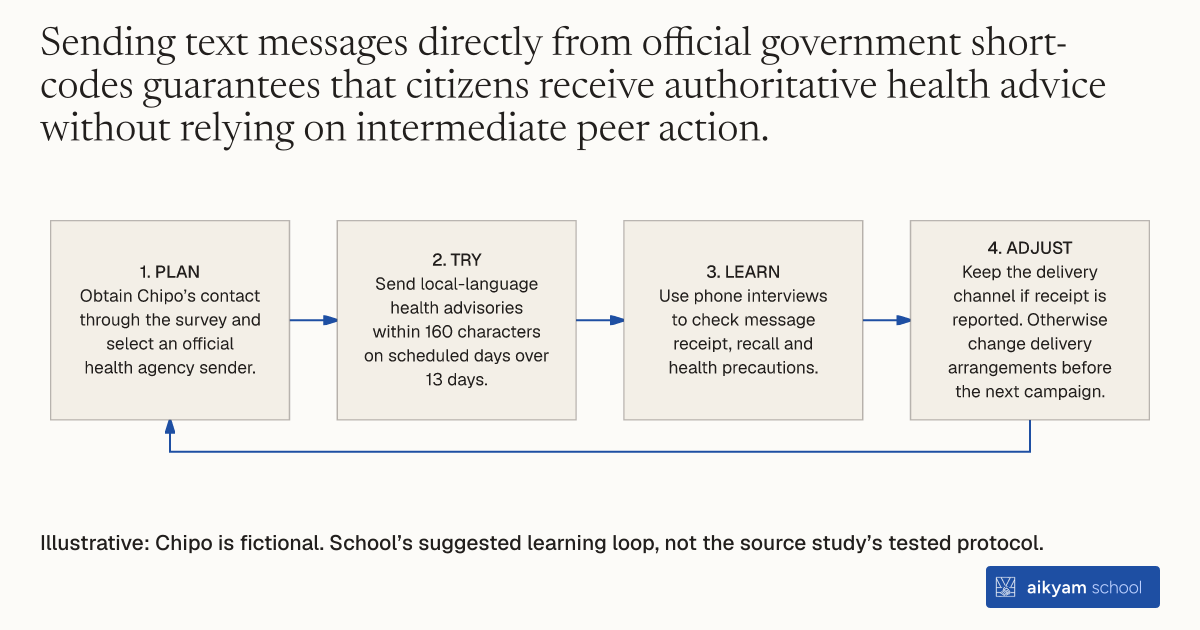
- Plan: Obtain Chipo’s contact through the survey and select an official health agency sender.
- Try: Send local-language health advisories within 160 characters on scheduled days over 13 days.
- Learn: Use phone interviews to check message receipt, recall and health precautions.
- Adjust: Keep the delivery channel if receipt is reported. Otherwise change delivery arrangements before the next campaign.
Illustrative: Chipo is fictional. School’s suggested learning loop, not the source study’s tested protocol.
See source →School’s suggested learning loop, not the source’s tested procedure. Observe receipt and health precautions separately. Direct messaging showed no statistically significant precautionary behaviour effects.
How
When to use
Public health authorities need reliable channels to send official health guidance directly to community members during health emergencies. Peer-to-peer forwarding relies on intermediary citizens who may fail to transmit messages or dilute the source's authority. Direct short-code text messaging delivers health advisories directly from central government bodies straight to individuals' mobile phones.
Deliver official health advisories directly to target citizens using official health agency short-codes.
- Obtain phone contact lists for community members from primary survey participants.
- Select an official sender identity from institutional public health agencies such as the Ministry of Health or National Public Health Institute.
- Transmit standardized health advisories to registered contacts using official short-code text channels on scheduled days over a 13-day period.
- Deliver health text messages formatted in local languages to fit within standard 160-character mobile limits.
- Survey recipients through multi-round phone interviews to evaluate message recall and protective health practices.
Why it works
Direct messaging establishes institutional credibility and reaches targeted phone contacts reliably.
Example
In Zambia, research teams sent short-code SMS advisories directly from the Ministry of Health or National Public Health Institute to 2,092 nominated contacts, increasing reported message receipt by 32 to 35 percentage points in survey round 3 compared to 28% in the control group.
About the study
Participants
751 primary participants and 2,092 peer contacts in Zambia; primary participants were aged 18+, 45.7% female, 47.6% aged 20-29, 45.9% with secondary education, and 34.6% residing in Lusaka.
Study Design
Randomized controlled trial comparing direct short-code text messaging (T3) against a control group (T0) and peer-forwarding arms (T1 and T2), with outcome measurement across three endline survey rounds.
Results
In survey round 3, direct short-code messaging increased reported message receipt by 32 percentage points for Ministry of Health messages and 35 percentage points for ZNPHI messages over the control baseline (28%), but produced no statistically significant changes in precautionary health behaviors.