Try, learn and adjust
Check local sanitation progress records
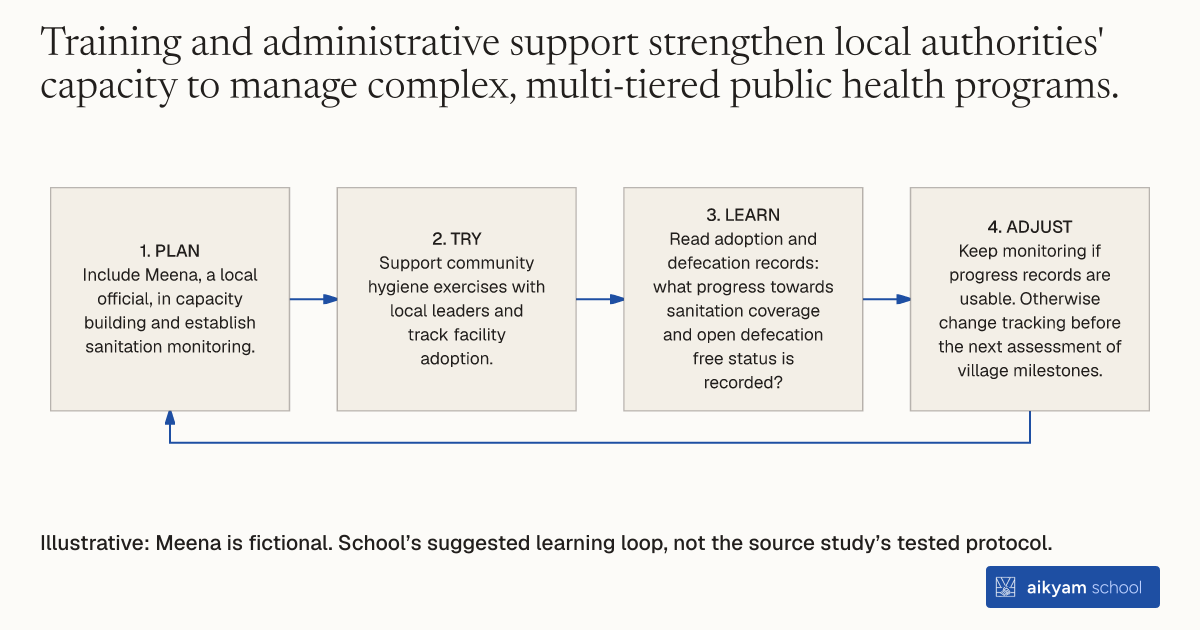
- Plan: Include Meena, a local official, in capacity building and establish sanitation monitoring.
- Try: Support community hygiene exercises with local leaders and track facility adoption.
- Learn: Read adoption and defecation records: what progress towards sanitation coverage and open defecation free status is recorded?
- Adjust: Keep monitoring if progress records are usable. Otherwise change tracking before the next assessment of village milestones.
Illustrative: Meena is fictional. School’s suggested learning loop, not the source study’s tested protocol.
See source →School’s suggested learning loop, not a source-tested procedure. Observe adoption records and village milestones; the wider campaign’s effects cannot be assigned to capacity building alone.
How
When to use
Rural sanitation programs often struggle due to weak administrative capacity and poor tracking of progress among local authorities. Government institutions and local leaders need structural support to execute large-scale hygiene initiatives effectively. This method provides training and monitoring infrastructure to local authorities implementing rural sanitation campaigns.
Strengthen rural sanitation implementation by delivering institutional capacity building and setting up tracking systems for local authorities.
- External development partners provide capacity building support to local government authorities across targeted districts.
- Local officials establish monitoring systems to assess ongoing progress toward sanitation coverage targets.
- Facilitators lead community exercises in rural villages to encourage hygiene behavior change alongside local leaders.
- Administrative teams track sanitation facility adoption data to verify village-wide open defecation free milestones.
Why it works
Systematic monitoring provides real-time progress data, enabling timely program adjustments and verification of sanitation coverage.
Example
In ten districts of rural Madhya Pradesh, India, the World Bank provided capacity building support and helped set up monitoring systems for local authorities implementing the Total Sanitation Campaign. Evaluated across 40 treatment villages, this institutional support contributed to raising household access to WHO-compliant improved latrines from 22.4 percent to 41.4 percent.
About the study
Participants
80 rural villages across two districts in Madhya Pradesh, India, focusing on local authorities and households with young children.
Study Design
Randomized evaluation comparing 40 villages receiving World Bank-supported capacity building and Total Sanitation Campaign implementation against 40 comparison villages.
Results
The intervention increased the proportion of households with WHO-compliant improved sanitation facilities to 41.4 percent (a 19 percentage point increase over comparison villages) and reduced daily open defecation by 11 to 12 percent among adults, though child health outcomes did not significantly change.