Research steps
Classify household credit barriers
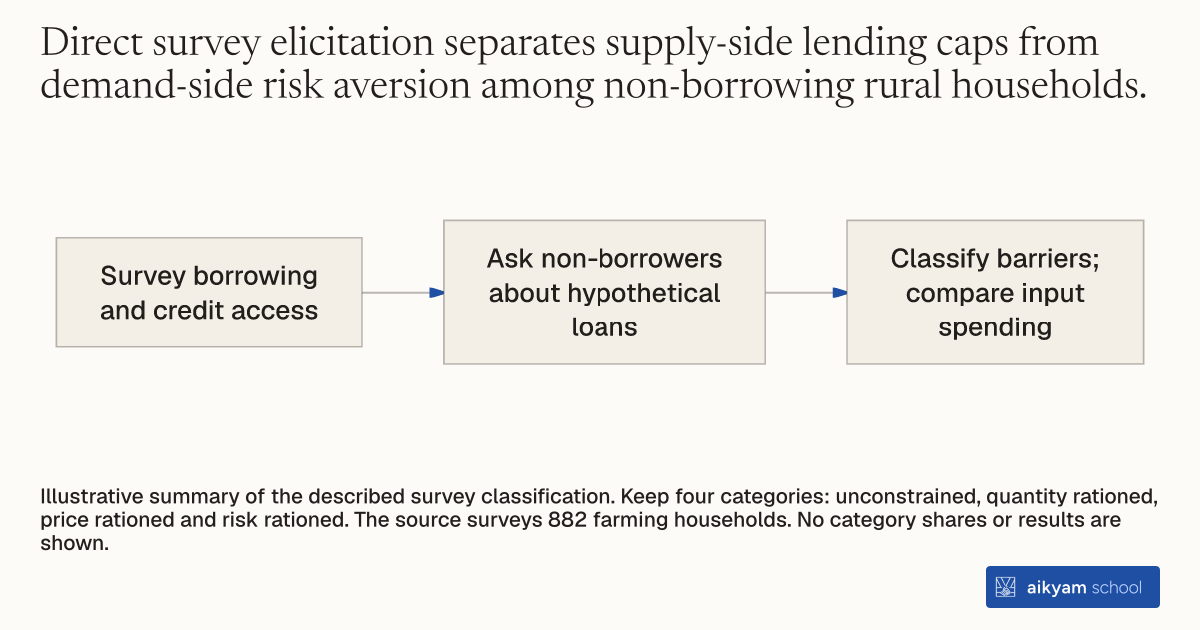
- Survey borrowing and credit access
- Ask non-borrowers about hypothetical loans
- Classify barriers; compare input spending
Illustrative summary of the described survey classification. Keep four categories: unconstrained, quantity rationed, price rationed and risk rationed. The source surveys 882 farming households. No category shares or results are shown.
See source →How
When to use
Smallholder farmers in developing countries often face heterogeneous credit market barriers that limit agricultural investment. Standard surveys conflate risk aversion with bank supply rejection or lack of demand. Direct household credit constraint classification identifies specific borrowing barriers to target agricultural finance interventions effectively.
Categorize rural farming households into explicit credit constraint categories using direct survey elicitation modules.
- Administer a structured survey module to household heads assessing borrowing history, loan applications, and formal credit availability.
- Filter non-borrowing households into voluntary non-borrowers and supply-constrained applicants rejected by formal lenders.
- Present hypothetical credit scenarios to unconstrained non-borrowers to determine whether high interest rates or risk aversion prevents loan requests.
- Classify households into four mutually exclusive categories: unconstrained, quantity rationed, price rationed, and risk rationed.
- Cross-tabulate credit constraint categories against household demographic indicators and seasonal agricultural input expenditures.
Why it works
Distinguishing risk-rationed farmers allows policymakers to deploy targeted risk-mitigation tools like index insurance rather than expanding nominal credit supply.
Example
Researchers surveyed 882 cooperative farming heads in Amhara, Ethiopia, classifying 54.6% as unconstrained, 18.8% as quantity rationed, 6.8% as price rationed, and 19.8% as risk rationed, finding that risk-rationed farmers used 42 kg less fertilizer than unconstrained households.
About the study
Participants
882 cooperative farming households across 49 villages in Amhara Region, Ethiopia.
Study Design
Baseline survey elicitation based on Boucher et al. (2008) methodology categorizing credit market status combined with cross-sectional input demand regressions.
Results
Identified 54.6% unconstrained, 18.8% quantity rationed, 6.8% price rationed, and 19.8% risk rationed households; risk-rationed households applied 42 kg less fertilizer (p < 0.01) and spent 33% less on total agricultural inputs than unconstrained households.