Research procedure
Proposed insurance-linked loan
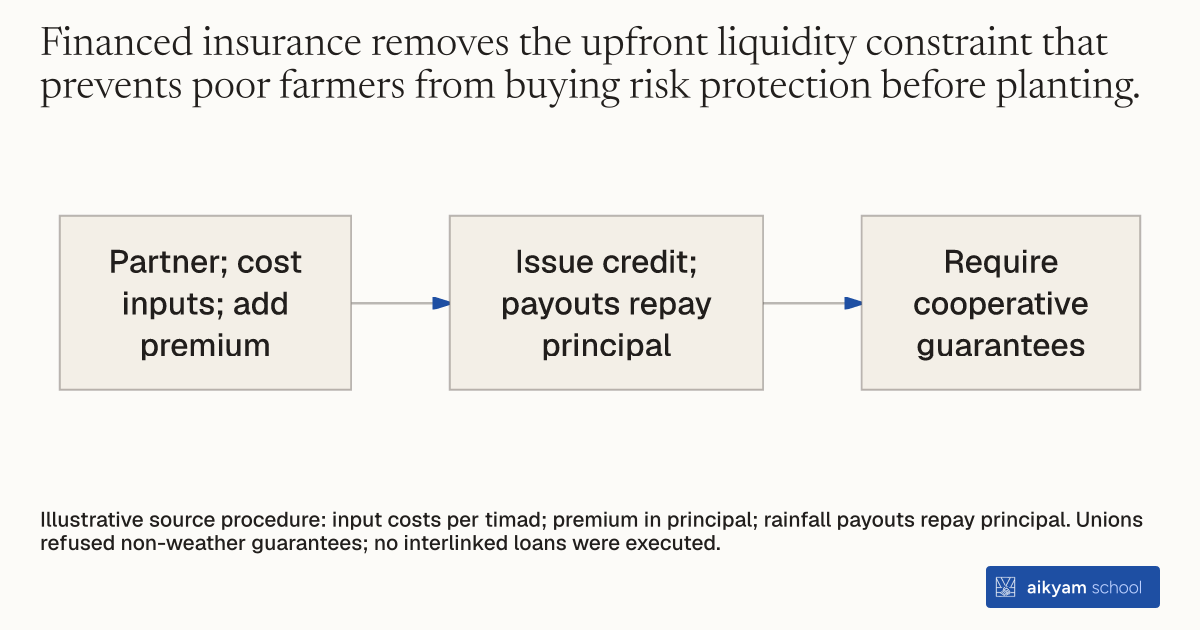
- Partner; cost inputs; add premium
- Issue credit; payouts repay principal
- Require cooperative guarantees
Illustrative source procedure: input costs per timad; premium in principal; rainfall payouts repay principal. Unions refused non-weather guarantees; no interlinked loans were executed.
See source →How
When to use
Smallholder farmers in drought-prone regions often refuse profitable seasonal agricultural loans because an unhedged weather shock could force them to liquidate productive assets to repay the debt. Lenders also ration credit supply when farmers face substantial weather risk outside their control. Interlink weather index insurance directly with seasonal agricultural credit to remove default fear and unlock working capital for input purchases.
Offer smallholders production credit bundled with weather index insurance to reduce default risk from rainfall shocks.
- Partner a private commercial bank with an insurance provider and local cooperative unions to structure a joint credit-insurance contract.
- Calculate the total cost of recommended seasonal crop inputs like inorganic fertilizer and improved seeds per timad of land.
- Bundle the weather index insurance premium directly into the loan principal so farmers do not pay cash upfront before planting.
- Issue seasonal input credit to cooperative members, with insurance payouts going directly to settle loan principal if rainfall falls below the index threshold.
- Require local cooperative unions to guarantee loan default risks arising from non-weather causes like pest infestations or managerial failure.
Why it works
Linking insurance payouts to debt obligations shields farmers from losing collateral while protecting lenders from climate-driven default cascades.
Example
In Amhara, Ethiopia, researchers partnered with Dashen Bank, Nyala Insurance, and primary cooperative unions to pilot interlinked loan-insurance contracts across 17 treatment villages. Cooperative members who took up insurance in interlinked villages purchased higher coverage (average sum insured of 2,018 Birr) compared to those in standalone insurance villages (average sum insured of 1,295 Birr).
About the study
Participants
N = 460 rural smallholder households across 23 treatment primary cooperative villages in Amhara, Ethiopia.
Study Design
Field randomized control trial comparing interlinked credit-insurance contracts against standalone insurance contracts, with randomized individual subsidy vouchers.
Results
Primary cooperative unions refused to guarantee non-weather default risks, causing the credit component to fail and resulting in zero interlinked loan executions. However, insured farmers in interlinked villages demanded a significantly higher average sum insured (2,018 Birr vs 1,295 Birr, p < 0.10) expecting access to credit.