Try, learn and adjust
Check instant electric vehicle discounts
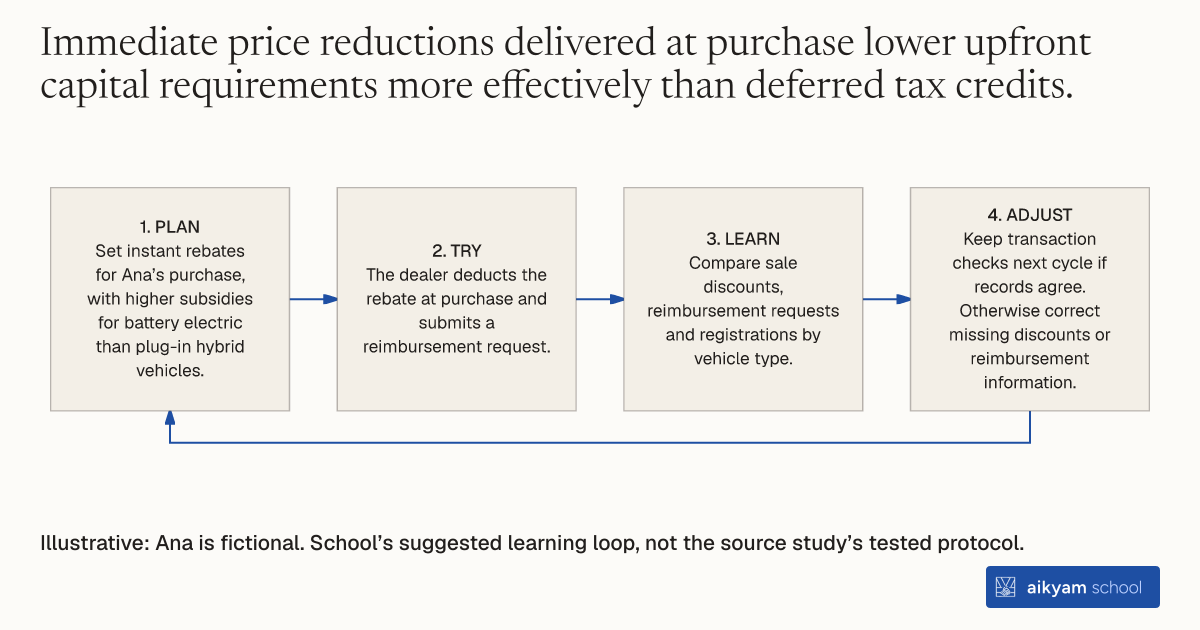
- Plan: Set instant rebates for Ana’s purchase, with higher subsidies for battery electric than plug-in hybrid vehicles.
- Try: The dealer deducts the rebate at purchase and submits a reimbursement request.
- Learn: Compare sale discounts, reimbursement requests and registrations by vehicle type.
- Adjust: Keep transaction checks next cycle if records agree. Otherwise correct missing discounts or reimbursement information.
Illustrative: Ana is fictional. School’s suggested learning loop, not the source study’s tested protocol.
See source →School’s suggested learning loop: observe point-of-sale discounts, dealer claims and vehicle registrations; records alone do not establish additional vehicle adoption.
How
When to use
High upfront purchase prices for electric vehicles delay consumer adoption and fleet transition. Deferred income tax credits or annual sales tax waivers fail to incentivize car buyers as effectively as immediate price reductions. Point-of-sale direct purchase rebates lower initial financial barriers for prospective vehicle buyers.
Provide point-of-sale direct rebates for residential buyers purchasing battery electric vehicles or plug-in hybrid electric vehicles.
- Structure municipal vehicle incentive frameworks to offer instant discounts directly at vehicle dealerships.
- Set higher subsidy amounts for battery electric vehicles than plug-in hybrid electric vehicles.
- Require participating auto dealers to deduct the subsidy amount from the retail vehicle price at purchase.
- Submit dealer reimbursement requests through municipal administration portals.
- Track battery electric vehicle and plug-in hybrid electric vehicle registration volumes to assess policy impact.
Why it works
Consumers also show a stronger market adoption response when subsidies target pure battery electric vehicles over plug-in hybrids.
Example
State and municipal vehicle programs across the United States offered purchase rebates, tax credits, and sales tax waivers to automobile buyers. Evaluators found that point-of-sale purchase rebates increased battery electric vehicle and plug-in hybrid electric vehicle adoption significantly more than deferred tax credits.
About the study
Participants
Vehicle registration and sales datasets across electric vehicle buyers nationwide in the United States.
Study Design
Difference-in-differences with synthetic controls and generalized propensity score matching comparing adoption across state incentive structures.
Results
Direct purchase rebates proved more effective at boosting adoption of battery electric vehicles and plug-in hybrid electric vehicles than tax credits and sales tax waivers, with battery electric vehicles exhibiting stronger adoption responses to subsidies.