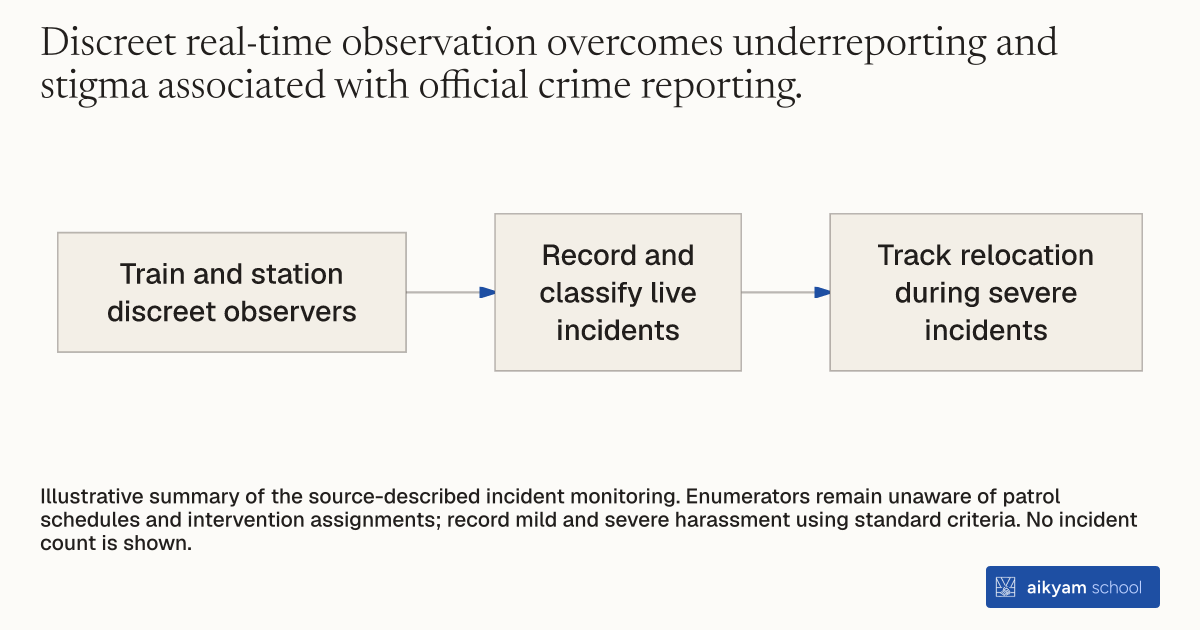
Research steps
Observe harassment independently
- Train and station discreet observers
- Record and classify live incidents
- Track relocation during severe incidents
Illustrative summary of the source-described incident monitoring. Enumerators remain unaware of patrol schedules and intervention assignments; record mild and severe harassment using standard criteria. No incident count is shown.
See source →How
When to use
Measuring street harassment through official police logs or self-reported surveys often suffers from underreporting and social stigma. Evaluating law enforcement interventions requires objective, real-time data on harassment frequency in public areas. Deploy trained, independent enumerators to observe and record incidents discreetly without alerting police or perpetrators.
Track public street harassment incidents in real time using independent enumerators kept blind to police intervention schedules.
- Recruit and train independent enumerators on specific classifications of public harassment.
- Station enumerators discreetly at designated urban public hotspots during monitoring periods.
- Keep enumerators unaware of police patrolling schedules and intervention group assignments.
- Record observed harassment incidents in real time as they occur in public view.
- Classify each incident into mild harassment or severe harassment based on standardized behavior criteria.
- Track women's relocation behaviors when severe harassment occurs in the observed area.
Why it works
Keeping enumerators blind to police activities prevents observer bias when evaluating intervention impacts.
Example
Researchers stationed trained enumerators across 350 public hotspots in Hyderabad, India, to record street harassment incidents and women's relocation behaviors in real time.
About the study
Participants
350 hotspots in Hyderabad, India.
Study Design
Double-blind real-time observation by trained enumerators across 100 uniformed patrol, 100 undercover patrol, and 150 comparison hotspots.
Results
Enumerator incident tracking captured a 27 percent decline in severe harassment incidents (0.7 fewer women harassed per week per hotspot) and a 30 percent reduction in women relocating due to severe harassment in uniformed patrol areas.