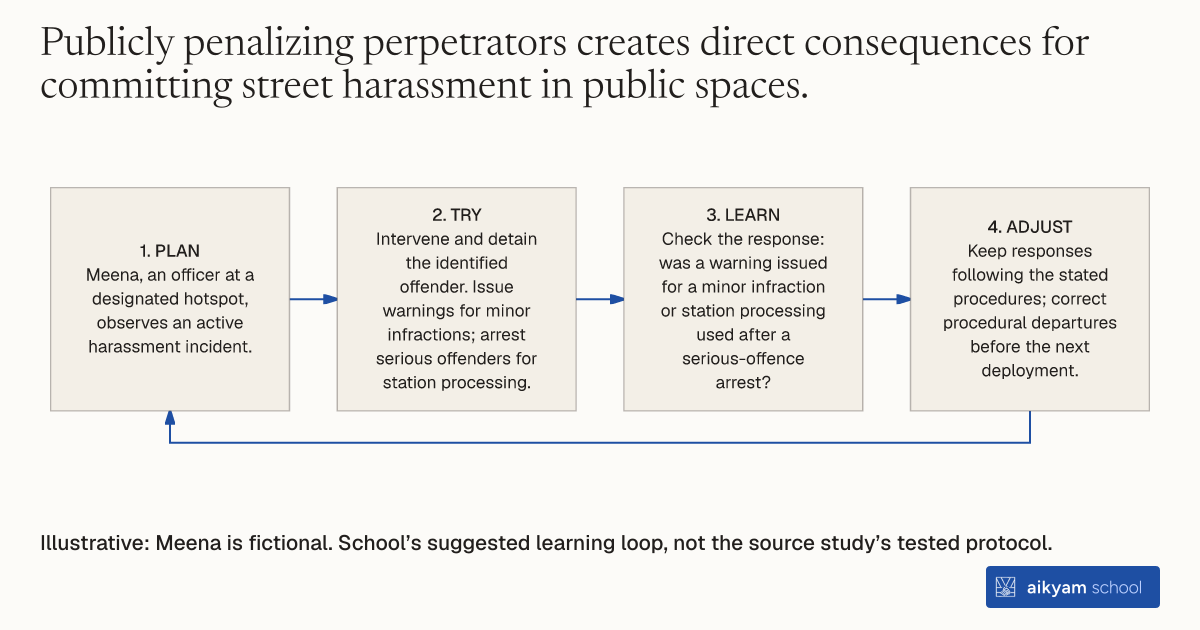
Try, learn and adjust
Check that responses follow the stated offence distinction
- Plan: Meena, an officer at a designated hotspot, observes an active harassment incident.
- Try: Intervene and detain the identified offender. Issue warnings for minor infractions; arrest serious offenders for station processing.
- Learn: Check the response: was a warning issued for a minor infraction or station processing used after a serious-offence arrest?
- Adjust: Keep responses following the stated procedures; correct procedural departures before the next deployment.
Illustrative: Meena is fictional. School’s suggested learning loop, not the source study’s tested protocol.
See source →School’s suggested learning loop, not a tested protocol. Observe the stated warning and arrest routes. This loop is not a legal enforcement protocol.
How
When to use
Street harassment in public spaces often persists because offenders face no immediate consequences or public sanctions. Perpetrators operate with impunity when law enforcement presence lacks visible enforcement actions. Implement immediate penalization protocols by detaining perpetrators, issuing formal warnings, and bringing offenders to police stations.
Publicly penalize perpetrators caught engaging in street harassment in public spaces to enforce legal standards and signal police deterrence.
- Intervene immediately upon observing instances of mild or severe sexual harassment in designated public locations.
- Detain identified offenders at the scene of the incident.
- Issue formal police warnings to perpetrators on site for minor infractions.
- Arrest individuals committing serious sexual harassment offenses.
- Transport arrested offenders directly from public hotspots to local police stations for formal processing.
Why it works
Detaining offenders and taking them to police stations demonstrates active law enforcement, discouraging further offensive behavior.
Example
Hyderabad City Police deployed SHE Teams across Hyderabad, India, to publicly penalize harassment perpetrators by arresting them, issuing formal warnings, and taking them to police stations.
About the study
Participants
350 hotspots in Hyderabad, India.
Study Design
A randomized controlled trial evaluating police patrolling and enforcement strategies across 100 uniformed patrol, 100 undercover patrol, and 150 comparison hotspots.
Results
Publicly penalizing perpetrators through active uniformed patrols reduced severe sexual harassment by 27 percent (0.7 fewer women harassed per week per hotspot) compared to unpatrolled hotspots.