Research procedure
Elicit choices about effort timing
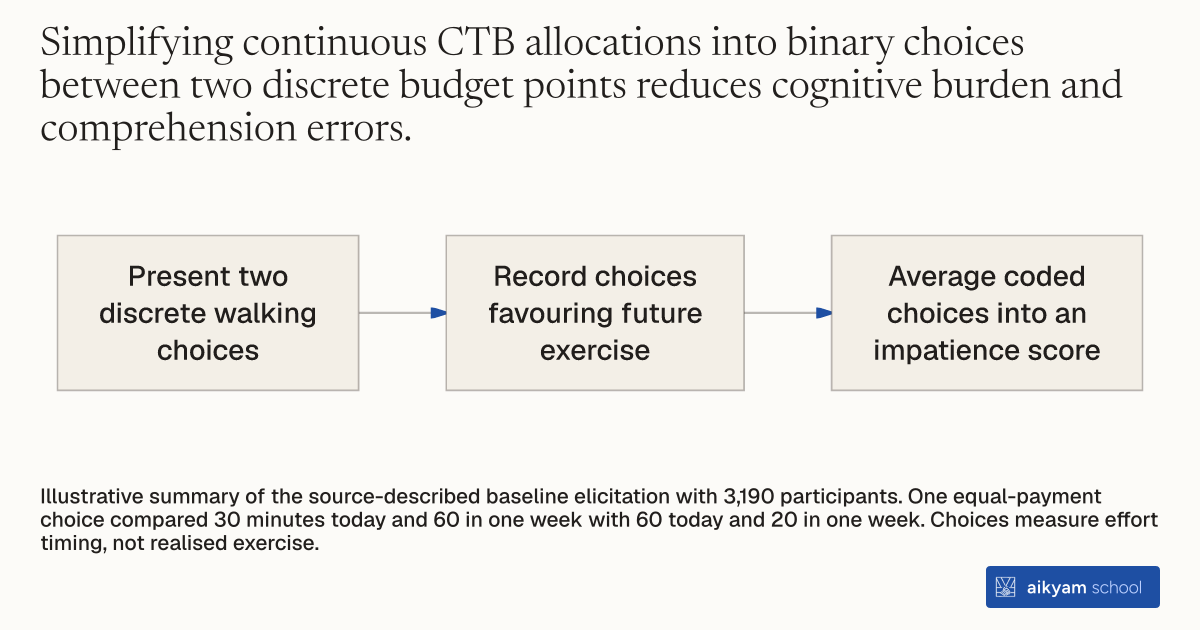
- Present two discrete walking choices
- Record choices favouring future exercise
- Average coded choices into an impatience score
Illustrative summary of the source-described baseline elicitation with 3,190 participants. One equal-payment choice compared 30 minutes today and 60 in one week with 60 today and 20 in one week. Choices measure effort timing, not realised exercise.
See source →How
When to use
Behavioral projects need to evaluate time preferences and discount factors specifically over effort rather than monetary payments. Standard continuous Convex Time Budget tasks can be overly complex for field populations with limited formal education. This method serves programs measuring effort impatience through simplified, discrete intertemporal budget choices.
Elicit intertemporal effort choices using simplified discrete pairs from a convex walking budget set to quantify effort impatience.
- Formulate pairs of physical activity allocations across two dates, such as walking today versus walking one week from today.
- Present participants with a binary choice between two discrete points along a convex effort budget, such as walking 30 minutes today and 60 minutes in one week versus walking 60 minutes today and 20 minutes in one week for equal payment.
- Administer two simple discrete CTB survey questions as warm-up exercises prior to or alongside baseline survey modules.
- Record whether the participant selects options that defer physical activity to the future date.
- Code an indicator for choosing the option with greater future exercise as a measure of effort impatience.
- Average the indicators across the questions to construct a composite discrete CTB impatience score.
Why it works
The discrete choice format reliably captures effort procrastination and correlates with baseline physical activity.
Example
Surveyors administered two simple discrete CTB effort choices to 3,190 adults with diabetes or high blood sugar in Coimbatore, India. Participants classified as effort-impatient by this measure walked significantly less at baseline, and the measure predicted a 4.70 percentage point higher compliance advantage under time-bundled threshold contracts relative to linear contracts.
About the study
Participants
3,190 participants in Coimbatore, India, with an average age of 49.56 years, 42 percent female, 67 percent diagnosed diabetic, and an average monthly per capita income of 4,465 INR.
Study Design
Surveyors presented two discrete CTB choices over physical activity allocations across time dates during baseline surveys, using the resulting impatience indicator to analyze baseline walking levels and treatment effect heterogeneity in a 12-week trial.
Results
The discrete CTB measure correlated with baseline exercise (impatient participants exercised less) and predicted a 4.70 percentage point increase in step-target compliance under time-bundled threshold contracts relative to linear base case contracts (p-value < 0.10).