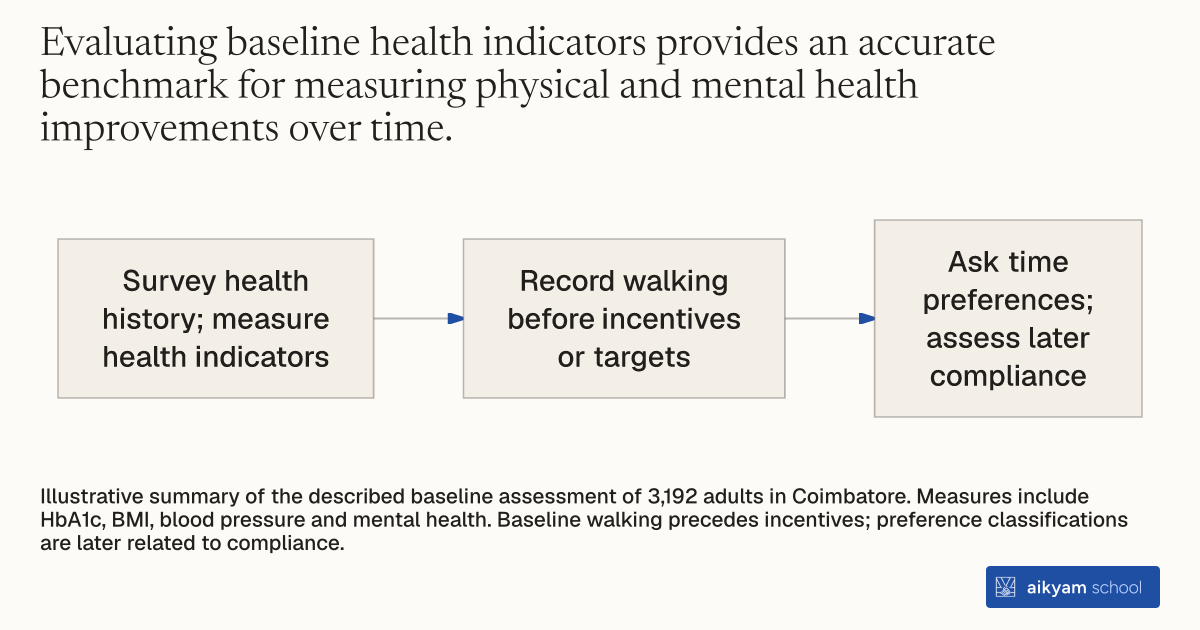
Research steps
Measure health and preferences before incentives
- Survey health history; measure health indicators
- Record walking before incentives or targets
- Ask time preferences; assess later compliance
Illustrative summary of the described baseline assessment of 3,192 adults in Coimbatore. Measures include HbA1c, BMI, blood pressure and mental health. Baseline walking precedes incentives; preference classifications are later related to compliance.
See source →How
When to use
Health programs targeting chronic conditions like diabetes need to establish initial health baselines and evaluate participant traits before starting an intervention. Behaviors like exercise have immediate effort costs while health benefits occur in the long run, causing impatient individuals to procrastinate. Assessing baseline health metrics and measuring time preferences allows programs to understand participant risk factors and tailor incentives effectively.
Conduct a comprehensive baseline survey combining health measurements, activity tracking, and preference elicitation questions.
- Administer a baseline health survey to collect demographic and medical history details.
- Measure physical health metrics including blood sugar (HbA1c), body mass index (BMI), blood pressure, and mental health indicators.
- Collect baseline walking data before introducing any incentive or target structure.
- Pose a series of preference questions to measure each participant's level of impatience and time preferences over financial and effort domains.
- Use the resulting preference classifications to evaluate how time preferences affect compliance with physical activity interventions.
Why it works
Measuring impatience directly helps identify individuals who discount future benefits and need targeted incentive structures to overcome exercise procrastination.
Example
In Coimbatore, India, researchers administered baseline health surveys and time preference assessments to 3,192 diabetic and prediabetic participants, finding that 82 percent had elevated HbA1c, 49 percent had hypertension, and 61 percent had obesity.
About the study
Participants
3,192 adults in Coimbatore, India, averaging 49 years old, where 67 percent had doctor-diagnosed diabetes, 82 percent had elevated HbA1c, 49 percent had hypertension, and 61 percent had obesity.
Study Design
A randomized controlled trial evaluating physical activity incentives and step-monitoring contracts among recruited adults across eight intervention and comparison groups over twelve weeks.
Results
Baseline preference assessments identified impatient individuals, for whom threshold payments increased step target completion by 6 percentage points relative to patient individuals, whereas threshold payments decreased patient individuals' compliance by 3.4 percentage points.