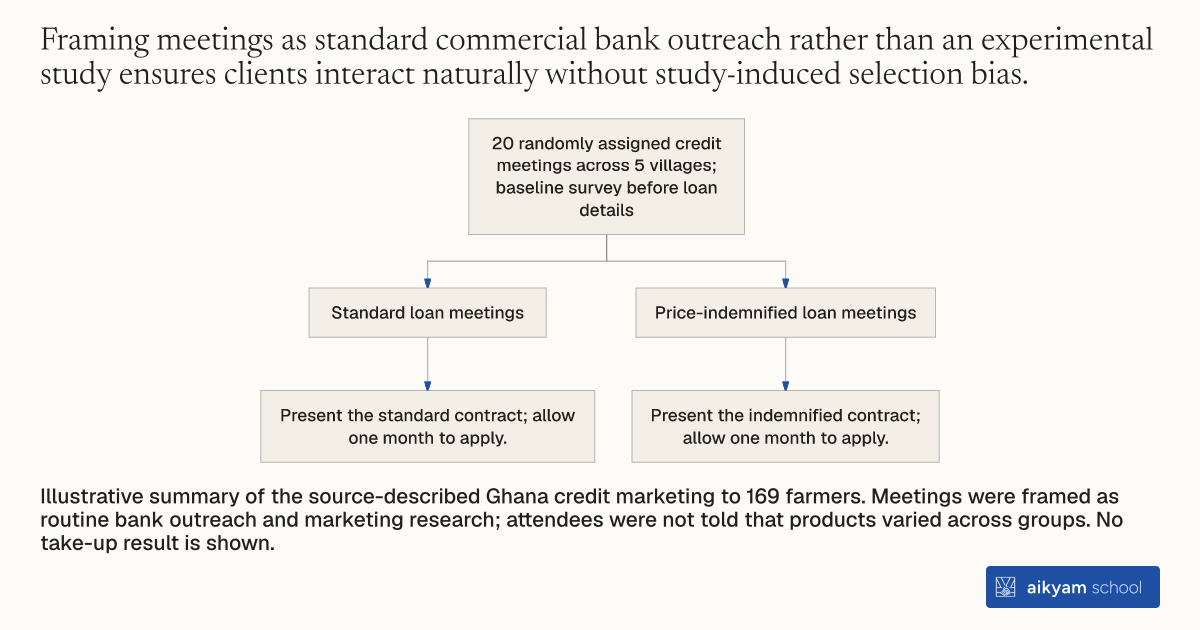
Research groups
Present assigned loans in separate group meetings
20 randomly assigned credit meetings across 5 villages; baseline survey before loan details
- Standard loan meetings
- Present the standard contract; allow one month to apply.
- Price-indemnified loan meetings
- Present the indemnified contract; allow one month to apply.
Illustrative summary of the source-described Ghana credit marketing to 169 farmers. Meetings were framed as routine bank outreach and marketing research; attendees were not told that products varied across groups. No take-up result is shown.
See source →How
When to use
This method applies when a financial institution or research team needs to test new microcredit product variations among smallholder farmers. It solves the problem of recruitment bias and Hawthorn effects where subjects alter borrowing behavior because they know they are participating in a research trial. The approach delivers distinct loan products across randomized group meetings while framing interactions as routine bank outreach.
Deliver distinct credit offers by conducting separate randomized group marketing meetings without disclosing product variations across groups.
- Rural bank credit officers schedule separate marketing meetings for target farmer groups in selected villages.
- Meeting facilitators inform attendees that the bank is conducting routine credit outreach and marketing research in their community.
- Facilitators administer a baseline survey gathering demographic, cognitive, and risk preference data before introducing loan details.
- Assigned credit officers present either the standard loan contract or the price-indemnified loan contract to the entire meeting group.
- Credit officers allow farmers one month following the meeting to submit loan applications at local bank branches.
Why it works
Group-based marketing also lowers administrative overhead for financial institutions explaining complex loan terms.
Example
In rural Eastern Ghana, Mumuadu Rural Bank credit officers conducted 20 group marketing meetings across 5 villages for 169 maize and garden egg farmers, presenting standard or indemnified loans without disclosing product variations across groups.
About the study
Participants
169 smallholder farmers (91 maize farmers, 78 garden egg farmers; 126 reached at follow-up) across 5 villages in rural Eastern Ghana.
Study Design
Natural field experiment where 20 community credit marketing meetings were randomly assigned to offer standard loans or loans with 50% crop price indemnification.
Results
Disguised group marketing achieved high overall loan take-up of 88.9% (86.4% control vs. 91.7% treatment, t = 0.942), avoiding recruitment bias while generating statistically balanced groups across baseline observables (joint F-test = 0.75, p = 0.74).