Try, learn and adjust
Check factory instructions and daily visual aids
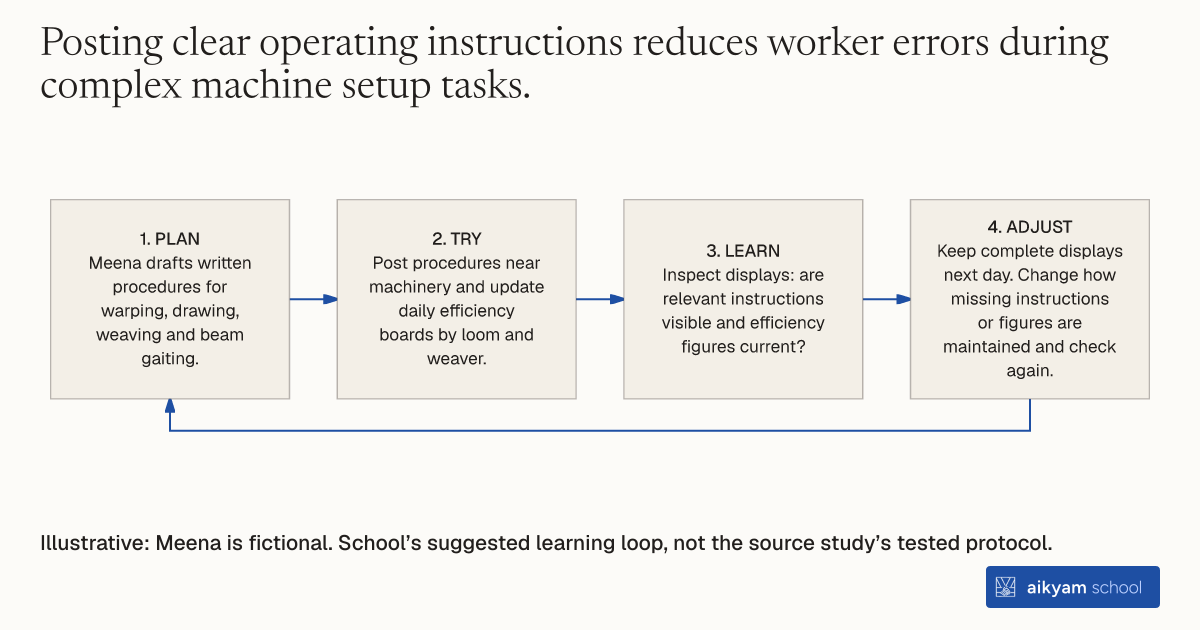
- Plan: Meena drafts written procedures for warping, drawing, weaving and beam gaiting.
- Try: Post procedures near machinery and update daily efficiency boards by loom and weaver.
- Learn: Inspect displays: are relevant instructions visible and efficiency figures current?
- Adjust: Keep complete displays next day. Change how missing instructions or figures are maintained and check again.
Illustrative: Meena is fictional. School’s suggested learning loop, not the source study’s tested protocol.
See source →Observe posted instructions and daily efficiency updates. School suggests this learning loop; it is not the source’s tested procedure.
How
When to use
Factory workers and machine operators often perform critical tasks like warping, weaving, or beam gaiting without standardized written instructions. Without posted guidance and daily efficiency charts, workers perform tasks inconsistently and lack clear visibility into daily loom performance. This method helps factory managers post written procedures and daily visual tracking boards across the shop floor.
Post written standard operating procedures for key factory processes and maintain daily visual tracking boards across production areas.
- Operations managers draft written procedures for warping, drawing, weaving, and beam gaiting processes.
- Factory workers display these written standard operating procedures clearly near relevant machinery on the shop floor.
- Floor supervisors set up visual display boards showing daily efficiency metrics by loom and by weaver.
- Supervisors update these visual tracking aids on a daily basis to show real-time production performance.
Why it works
Visual display boards encourage workers and supervisors to track daily loom efficiency and address operational slowdowns immediately.
Example
International consultants helped plant managers in woven cotton textile firms near Mumbai, India create visual boards and post standard operating procedures, raising adoption of daily visual aids from 0% to 64.3% across treatment plants.
About the study
Participants
28 plants across 17 large, family-owned cotton textile weaving firms in Tarapur and Umbergaon near Mumbai, India, averaging 273 employees and \$7.45 million in annual sales per firm.
Study Design
Randomized controlled trial providing 11 treatment firms with 5 months of management consulting and 6 control firms with 1 month of diagnostic consulting, tracking weekly data across ~100 weeks.
Results
Displaying standard procedures and visual aids alongside other lean manufacturing practices helped increase factory output by 9.4% (p = 0.026) and total factor productivity by 16.6% (p = 0.061), while visual aid adoption in treatment plants increased by 64.3 percentage points.