Research procedure
Evaluate voter information delivery
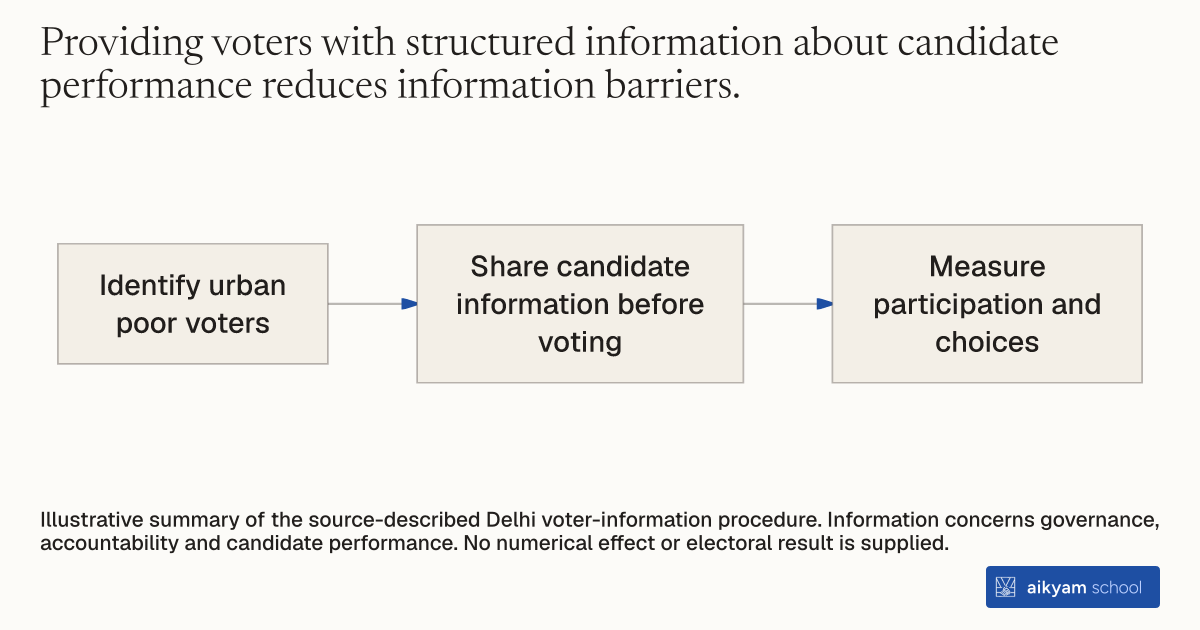
- Identify urban poor voters
- Share candidate information before voting
- Measure participation and choices
Illustrative summary of the source-described Delhi voter-information procedure. Information concerns governance, accountability and candidate performance. No numerical effect or electoral result is supplied.
See source →How
When to use
Urban voters in Delhi need targeted information to evaluate candidates during elections. This method addresses low voter turnout and limited electoral participation among the urban poor population. It provides information on governance and political accountability to help citizens make informed choices.
Deliver targeted political information to urban voters in Delhi to boost electoral participation and civic accountability.
- Researchers from J-PAL, EPoD, and IGC identify urban poor voter populations across Delhi, India.
- Field teams compile objective information regarding governance, candidate accountability, and performance.
- Program staff distribute the information interventions directly to targeted urban voters prior to municipal elections.
- Research teams measure electoral participation and voting choices across targeted urban communities.
Why it works
Informed voters can hold politicians accountable and improve overall electoral participation.
Example
Researchers Abhijit Banerjee, Selvan Kumar, Rohini Pande, and Felix Su evaluated an information intervention targeting urban voters in Delhi, India, registered under AEA RCT trial 259.
About the study
Participants
Urban population voters in Delhi, India.
Study Design
Randomized controlled trial (AEA RCT registration trial 259) conducted by J-PAL, EPoD, and IGC.
Results
Evaluated electoral participation outcomes as published in the MIT working paper "Do Informed Voters Make Better Choices? Experimental Evidence from Urban India."