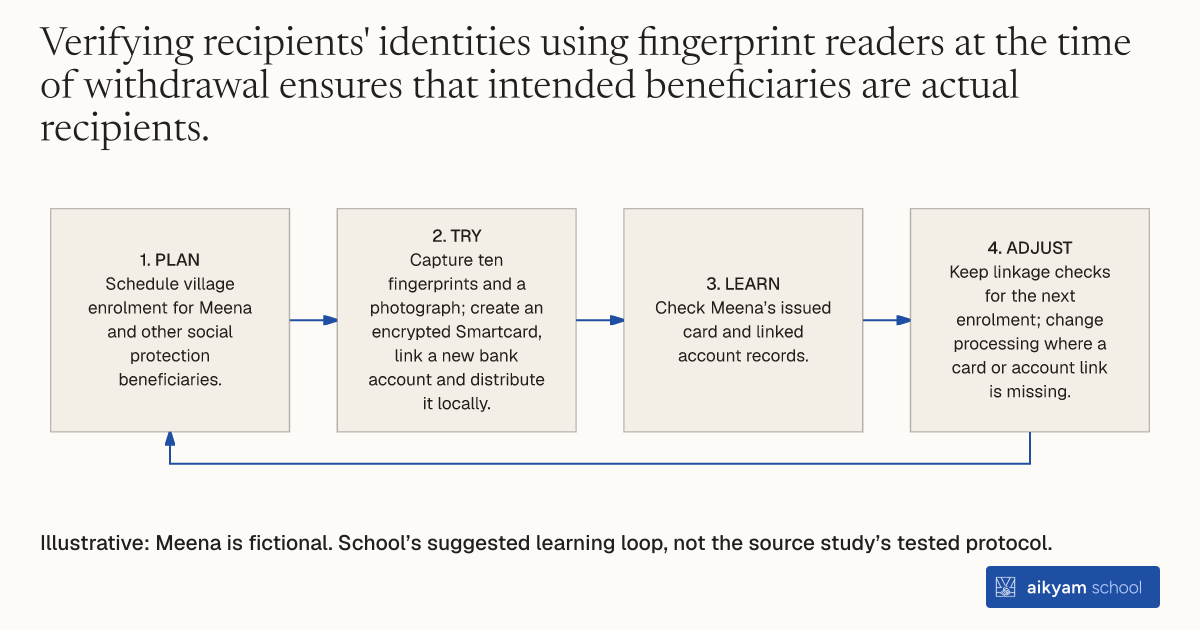
Try, learn and adjust
Check smartcards link to beneficiary accounts
- Plan: Schedule village enrolment for Meena and other social protection beneficiaries.
- Try: Capture ten fingerprints and a photograph; create an encrypted Smartcard, link a new bank account and distribute it locally.
- Learn: Check Meena’s issued card and linked account records.
- Adjust: Keep linkage checks for the next enrolment; change processing where a card or account link is missing.
Illustrative: Meena is fictional. School’s suggested learning loop, not the source study’s tested protocol.
See source →School’s suggested learning loop; not a tested source procedure. Observe enrolment, card distribution and account linkage. These checks alone do not establish the full payment system’s leakage effects.
How
When to use
When social assistance programs suffer from high leakage and delayed payments due to paper-based identification. It provides biometrically authenticated smartcards linked to bank accounts for rural program beneficiaries. This ensures that intended social assistance funds reach actual recipients directly without identity fraud or diversion.
Enroll beneficiaries by capturing biometric data to issue smartcards linked to bank accounts for secure payment verification.
- Local officials schedule enrollment drives in target villages to register rural beneficiaries for social protection programs.
- Beneficiaries attend the enrollment drive and submit ten fingerprints and a digital photograph to verify their identity.
- System operators create a uniquely identified Smartcard containing the encrypted biometric data for each registered individual.
- Administrative personnel open a new bank account for the beneficiary and link it directly to the generated Smartcard.
- Local customer service providers distribute the issued Smartcards to beneficiaries in their home villages for routine transaction verification.
Why it works
This prevents corrupt officials from claiming funds on behalf of fake or absent individuals.
Example
The Government of Andhra Pradesh launched the Smartcard system across eight districts, enrolling rural NREGS workers and SSP beneficiaries into a biometrically authenticated banking system. Despite partial implementation where 67 percent of treatment villages used Smartcards for NREGS after two years, the system reduced NREGS leakages by 41 percent and SSP leakages by 47 percent.
About the study
Participants
8,000 households in 8 districts of Andhra Pradesh, covering a rural population of nineteen million people.
Study Design
Cluster-randomized controlled trial across 296 sub-districts randomly assigned to early rollout (treatment) or delayed rollout (comparison) over two years.
Results
NREGS workers with Smartcards reported 24 percent higher weekly earnings of INR 35 and SSP beneficiaries reported a 5 percent increase of INR 12, while official government disbursements remained unchanged, representing an estimated US\$38.5 million annual leakage reduction for NREGS and US\$3.2 million for SSP.