Research steps
Allocate minikits by public lottery
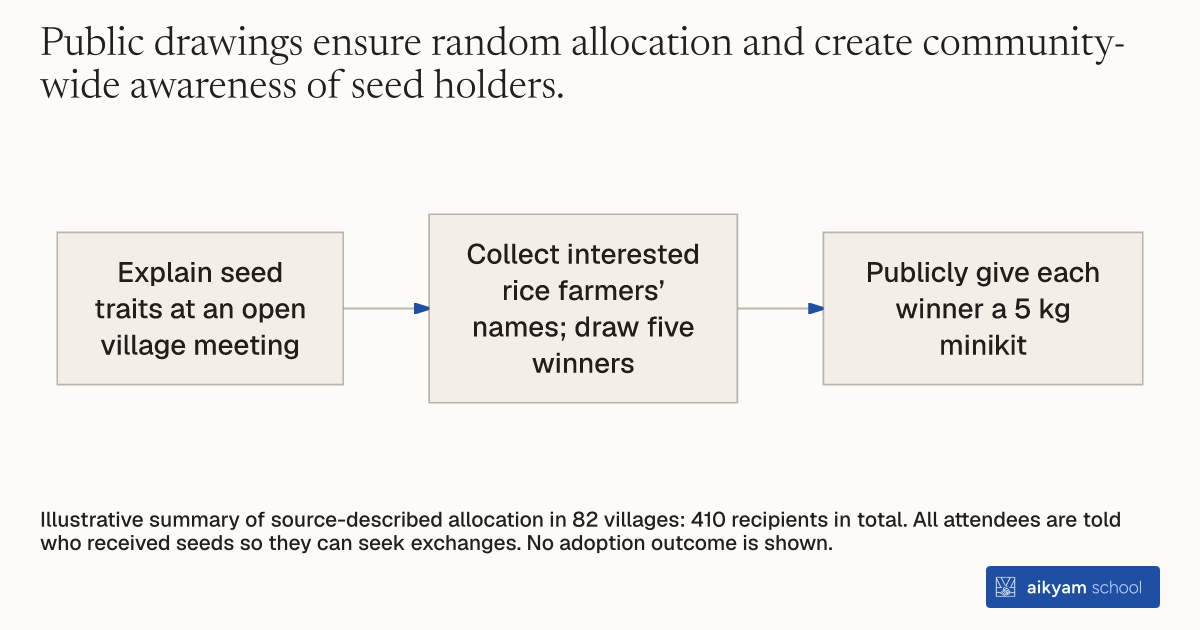
- Explain seed traits at an open village meeting
- Collect interested rice farmers’ names; draw five winners
- Publicly give each winner a 5 kg minikit
Illustrative summary of source-described allocation in 82 villages: 410 recipients in total. All attendees are told who received seeds so they can seek exchanges. No adoption outcome is shown.
See source →How
When to use
Agricultural extension programs need an unbiased way to distribute limited seed samples among interested local farmers. Handpicking recipients can create perceptions of favoritism or elite capture in rural communities. Public lotteries distribute seed minikits transparently while ensuring that all community members know who received the initial seeds.
Distribute seed minikits via public lotteries at the conclusion of open village information meetings.
- Program staff organize a public meeting in each target village to present new seed traits.
- Staff collect names from attending rice-cultivating farmers who want to try the new crop variety.
- Facilitators conduct a transparent public drawing at the end of the meeting to pick recipients.
- Program staff publicly award a 5 kg seed minikit to each of the 5 lottery winners in front of the assembled farmers.
- Facilitators inform all attendees who received seeds so farmers can seek out recipients for future exchanges.
Why it works
This transparency enables non-recipients to identify local seed sources and request seed trades or purchases.
Example
At the end of village meetings across 82 villages in Bhadrak district, Odisha, India, researchers publicly selected 5 attendees per village via lottery to receive 5 kg Swarna-Sub1 minikits, reaching 410 recipient farmers in total.
About the study
Participants
82 rural villages in Bhadrak district, Odisha, India, with 5 lottery recipients selected per village (410 total recipients) from an average meeting attendance of 22 farmers.
Study Design
Field experiment using public lotteries at the end of May 2012 meetings to randomly distribute 5 kg seed minikits containing enough seeds for 10 to 20 percent of an average land holding.
Results
Public lottery distribution provided seed minikits to 5 farmers per village, achieving 7 percent organic peer-to-peer adoption in social network diffusion villages compared to 41 percent adoption in direct door-to-door sales villages.