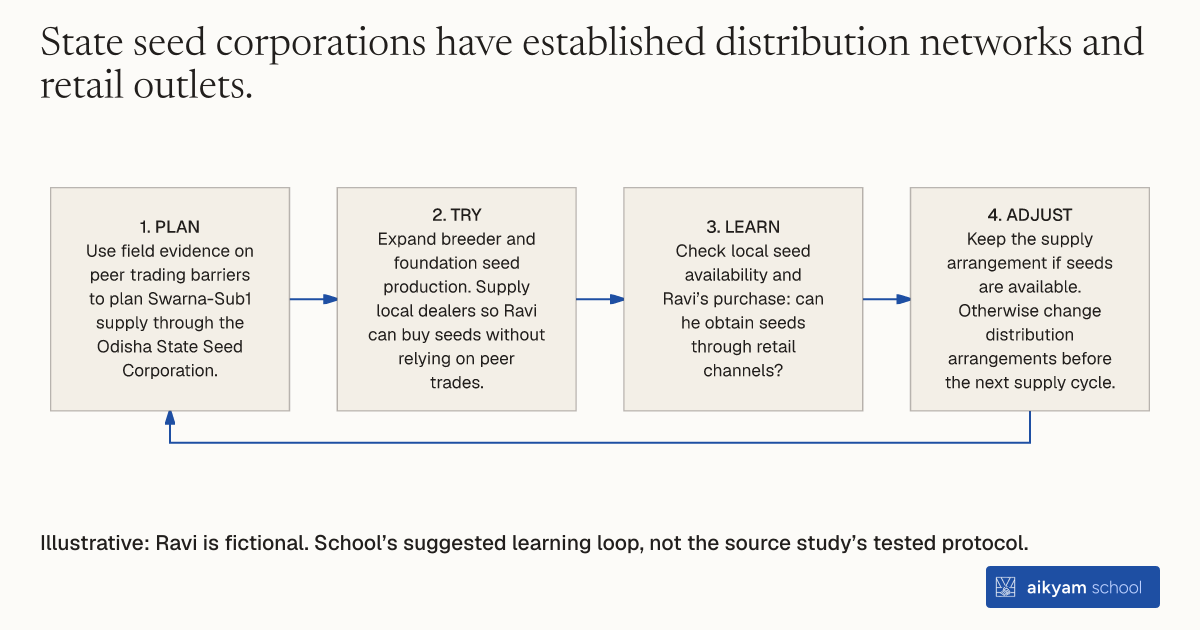
Try, learn and adjust
Check seed availability through retail channels
- Plan: Use field evidence on peer trading barriers to plan Swarna-Sub1 supply through the Odisha State Seed Corporation.
- Try: Expand breeder and foundation seed production. Supply local dealers so Ravi can buy seeds without relying on peer trades.
- Learn: Check local seed availability and Ravi’s purchase: can he obtain seeds through retail channels?
- Adjust: Keep the supply arrangement if seeds are available. Otherwise change distribution arrangements before the next supply cycle.
Illustrative: Ravi is fictional. School’s suggested learning loop, not the source study’s tested protocol.
See source →School’s suggested, untested loop: observe retail availability and purchases; the partnership’s impact is not established by this check.
How
When to use
Agricultural extension programs often rely on lead-farmer minikit distribution to spread new crop varieties, but informal trading frictions prevent wide adoption. Relying on lead farmers leaves many community members without access to flood-tolerant varieties. Partnering directly with state seed corporations makes seeds widely available through formal market and retail channels.
Distribute new crop seed varieties through state-run seed production and distribution institutions.
- Policy makers evaluate field evidence showing severe lead-farmer trading frictions.
- Development institutions partner with the regional Odisha State Seed Corporation.
- Program managers scale up breeder and foundation seed production through official state channels.
- State seed corporations supply flood-tolerant seeds directly to local commercial dealers and retail outlets.
- Local farmers purchase seeds directly from retail markets without relying on informal peer trades.
Why it works
Supplying seeds directly through institutional channels removes dependency on local social networks and eliminates peer-to-peer trading frictions.
Example
Following trial results showing low peer-to-peer diffusion, the International Rice Research Institute shifted from lead-farmer minikit dissemination to working with the Odisha State Seed Corporation in India to expand Swarna-Sub1 seed availability.
About the study
Participants
82 rural villages in Bhadrak district, Odisha, India.
Study Design
Policy re-orientation based on RCT results comparing social network diffusion against direct sales benchmarks.
Results
Evidence of a 34 percentage point adoption gap between direct sales (41 percent) and informal peer diffusion (7 percent) led IRRI to pivot to state seed corporation partnerships.