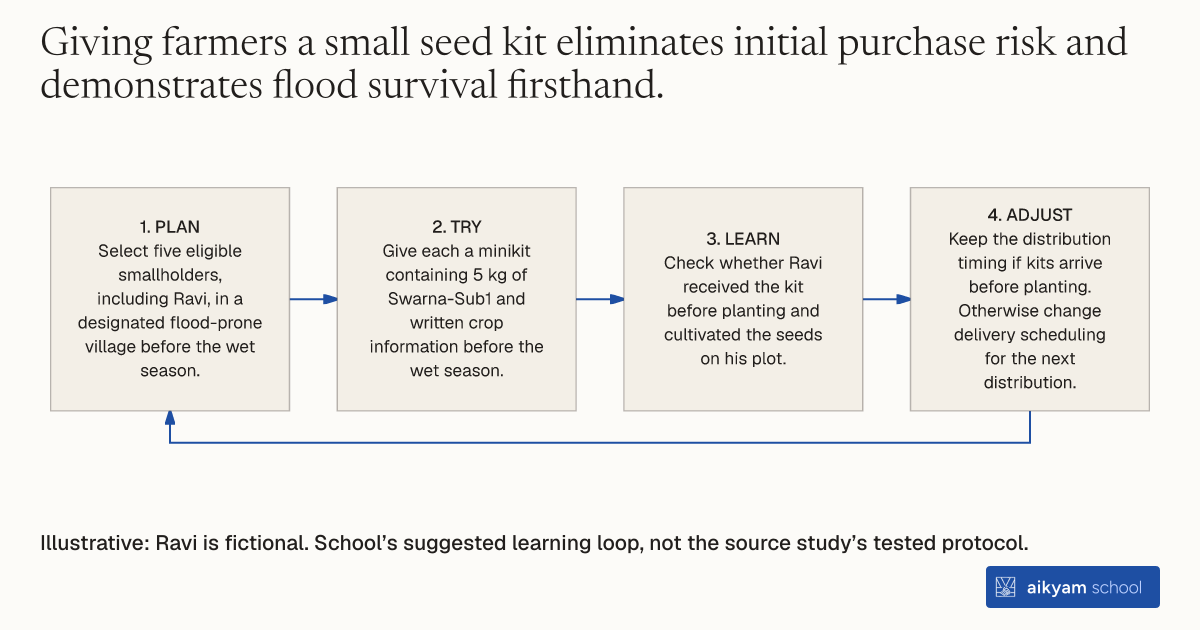
Try, learn and adjust
Check minikits reach selected farmers before planting
- Plan: Select five eligible smallholders, including Ravi, in a designated flood-prone village before the wet season.
- Try: Give each a minikit containing 5 kg of Swarna-Sub1 and written crop information before the wet season.
- Learn: Check whether Ravi received the kit before planting and cultivated the seeds on his plot.
- Adjust: Keep the distribution timing if kits arrive before planting. Otherwise change delivery scheduling for the next distribution.
Illustrative: Ravi is fictional. School’s suggested learning loop, not the source study’s tested protocol.
See source →School’s suggested learning loop: observe kit contents, timing and planting; this check does not establish yield effects.
How
When to use
Smallholder farmers in flood-prone areas face severe seasonal crop damage and avoid buying agricultural inputs due to weather risks. Direct seed minikit distribution introduces stress-tolerant seeds directly to vulnerable farmers before planting. It helps smallholders reduce flood losses and gain confidence to invest in their land.
Distribute small seed packages with guidance directly to farmers prior to the wet season.
- Program managers identify flood-prone agricultural villages in target districts before the wet season.
- Field staff select five eligible smallholder farmers in each designated participant village.
- Distributors assemble minikits that each contain a 5 kg bag of Swarna-Sub1 seeds alongside written information about the crop.
- Program staff offer one minikit directly to each selected farmer before the wet season begins.
- Farmers cultivate the seed package on their designated plots during the wet season.
Why it works
Seeing the seed survive submergence gives farmers confidence to invest in complementary inputs like fertilizer and expanded cultivation.
Example
In Bhadrak and Balasore districts, Odisha, researchers distributed 5 kg Swarna-Sub1 minikits to five farmers in each of 64 participant villages before the 2011 wet season. The seeds prevented 628 kg per hectare of yield loss during ten days of flooding and increased overall plot yields by 10 percent over two years.
About the study
Participants
128 villages in Bhadrak and Balasore districts, Odisha, India.
Study Design
Randomized evaluation offering 5 kg minikits with crop information to five farmers per participant village across 64 villages before the 2011 wet season compared to control villages.
Results
Avoided yield loss of 628 kg per hectare for ten days of flooding (a 45 percent advantage), increased plot yields by 10 percent over two years, and induced farmers to expand cultivated land and fertilizer use.