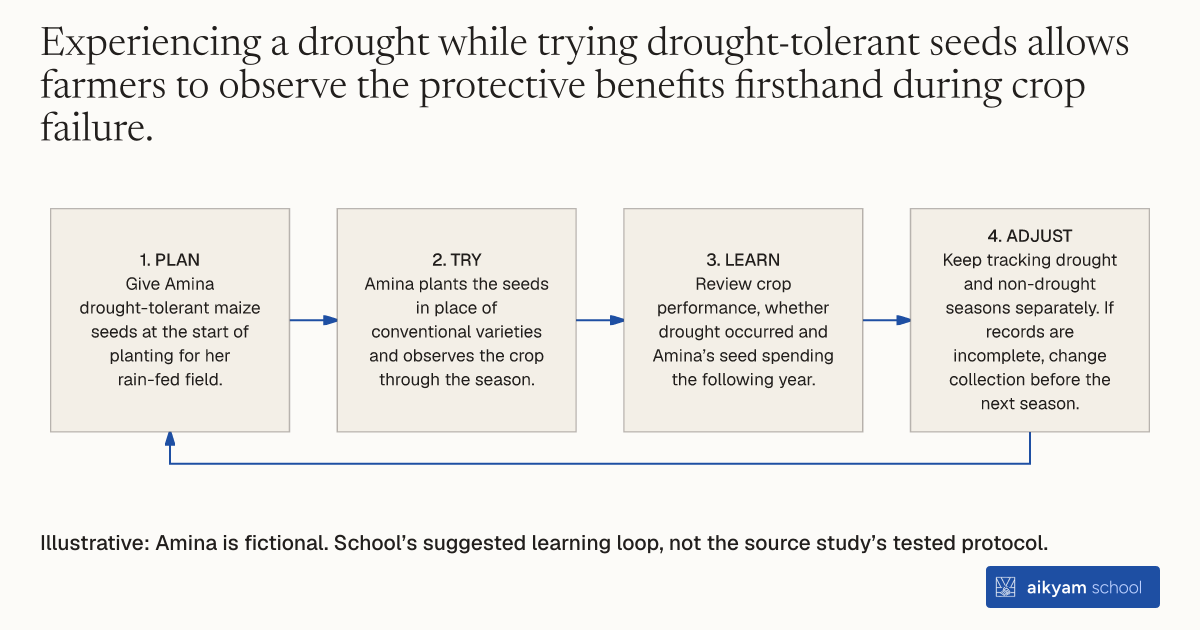
Try, learn and adjust
Check crop performance and later seed purchases
- Plan: Give Amina drought-tolerant maize seeds at the start of planting for her rain-fed field.
- Try: Amina plants the seeds in place of conventional varieties and observes the crop through the season.
- Learn: Review crop performance, whether drought occurred and Amina’s seed spending the following year.
- Adjust: Keep tracking drought and non-drought seasons separately. If records are incomplete, change collection before the next season.
Illustrative: Amina is fictional. School’s suggested learning loop, not the source study’s tested protocol.
See source →School’s suggested learning loop: observe weather, crop performance, seed spending and consumption; protected yields do not guarantee protected consumption.
How
When to use
Drought events reduce crop yields and increase income instability for rain-fed agricultural producers. Distributing drought-tolerant crop varieties helps farmers protect harvests against climate shocks. It targets smallholder farming households in dry and drought-prone agricultural regions.
Distribute drought-tolerant maize seeds to smallholder farmers to protect crop yields during drought events.
- Agricultural development programs distribute drought-tolerant maize seeds to smallholder farmers at the start of the planting season.
- Farmers plant drought-tolerant maize seeds in place of conventional crop varieties on rain-fed agricultural fields.
- Farmers observe crop performance during shock and non-shock growing seasons.
- Farmers purchase additional drought-tolerant seeds in subsequent years if they experience drought during initial trial seasons.
Why it works
Seeing these risk-mitigating effects encourages farmers to continue purchasing and using improved seeds in future seasons.
Example
In Tanzania and Mozambique, researchers evaluated farmers testing drought-tolerant maize seeds across shock and non-shock seasons. Farmers who experienced a drought during testing increased input spending on seeds the following year, whereas those without drought experience did not increase input spending. Farmers using drought-tolerant seeds avoided yield loss during severe drought, though seed use alone did not prevent consumption cuts.
About the study
Participants
Smallholder maize farmers in Tanzania and Mozambique.
Study Design
Randomized controlled trial tracking technology purchasing and input spending across drought and non-drought seasons.
Results
Farmers experiencing drought while testing drought-tolerant maize seeds increased input spending on seeds in the subsequent year, whereas those testing seeds without drought shocks did not increase subsequent input spending. Farmers adopting drought-tolerant seeds avoided crop yield losses during severe drought, but still experienced reduced consumption due to agricultural investment costs.