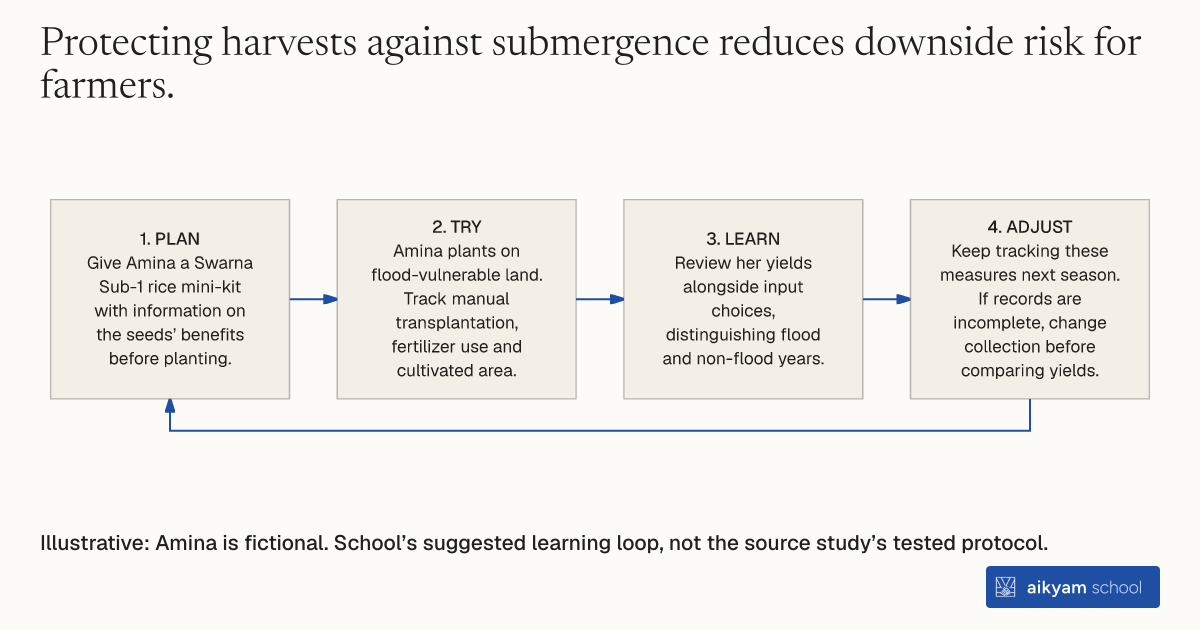
Try, learn and adjust
Check flood-tolerant seed use and farm inputs
- Plan: Give Amina a Swarna Sub-1 rice mini-kit with information on the seeds’ benefits before planting.
- Try: Amina plants on flood-vulnerable land. Track manual transplantation, fertilizer use and cultivated area.
- Learn: Review her yields alongside input choices, distinguishing flood and non-flood years.
- Adjust: Keep tracking these measures next season. If records are incomplete, change collection before comparing yields.
Illustrative: Amina is fictional. School’s suggested learning loop, not the source study’s tested protocol.
See source →School’s suggested learning loop: observe seed use, farm inputs and yields; it does not establish the study’s yield gain for Amina.
How
When to use
Flood events cause severe crop loss and discourage farmers from investing in productivity-enhancing practices. Distributing flood-tolerant seeds protects harvests against submergence and encourages investment in farm inputs. It targets smallholder rice farmers in flood-prone agricultural communities.
Distribute flood-tolerant seed mini-kits containing benefit information to smallholder rice farmers before planting.
- Extension providers supply farmers with mini-kits containing flood-tolerant Swarna Sub-1 rice seeds and informational material.
- Farmers plant flood-tolerant rice seeds on flood-vulnerable agricultural fields.
- Farmers adopt manual transplantation methods and increase fertilizer application rates across cultivated land.
- Farmers harvest crops during flood and non-flood years to secure increased agricultural yields.
Why it works
When downside risk drops, farmers invest more heavily in labor-intensive transplantation techniques and high-yield inputs like fertilizer.
Example
In India, researchers evaluated farmers offered mini-kits with flood-tolerant Swarna Sub-1 rice seeds and educational information. Recipient farmers increased fertilizer use, adopted manual transplantation, and cultivated additional land. These choices raised rice yields by approximately 10 percent in both flood and non-flood years compared to non-recipients.
About the study
Participants
Smallholder rice farmers in flood-prone agricultural regions of India.
Study Design
Randomized controlled trial evaluating the distribution of seed mini-kits with technical information against untreated farmers.
Results
Offering flood-tolerant seed mini-kits increased rice yields by about 10 percent in both flood and non-flood years. Recipient farmers were significantly more likely to adopt manual transplantation, apply higher levels of fertilizer, and cultivate additional farmland.