Research design
Counterbalance sensitive and control lists
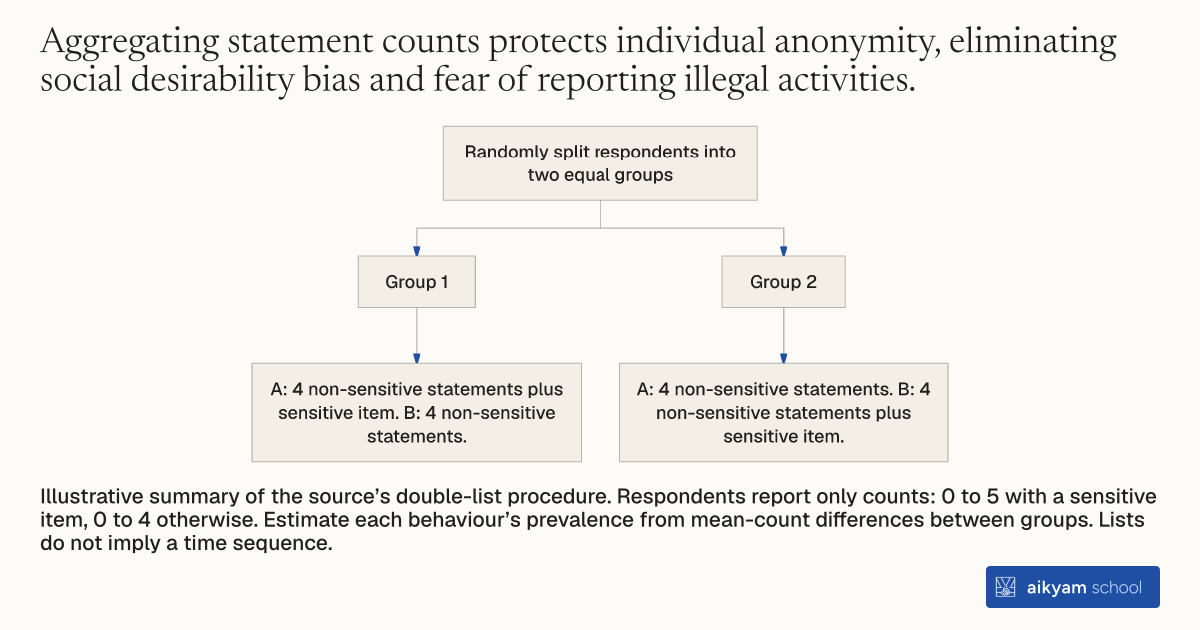
Randomly split respondents into two equal groups
- Group 1
- A: 4 non-sensitive statements plus sensitive item. B: 4 non-sensitive statements.
- Group 2
- A: 4 non-sensitive statements. B: 4 non-sensitive statements plus sensitive item.
Illustrative summary of the source’s double-list procedure. Respondents report only counts: 0 to 5 with a sensitive item, 0 to 4 otherwise. Estimate each behaviour’s prevalence from mean-count differences between groups. Lists do not imply a time sequence.
See source →How
When to use
In social policy evaluations in post-conflict or fragile settings, asking survey respondents directly about illegal or socially sensitive behaviors leads to social desirability bias and under-reporting. A double list experiment measures sensitive activities indirectly without forcing individuals to disclose personal participation. This method allows researchers to estimate population-level prevalence of risky behaviors among youth in employment programs.
Measure the prevalence of sensitive behaviors indirectly across survey respondents using a counterbalanced double list design.
- Select the specific sensitive behaviors to evaluate, such as stealing, assault, drug use, prostitution, or firearm possession.
- Construct for each sensitive item a control list of four non-sensitive affirmations and a treatment list containing the four non-sensitive affirmations plus the sensitive item.
- Randomly split the survey sample into two equal groups (Group 1 and Group 2).
- Present Group 1 with the sensitive list for item A and the control list for item B; present Group 2 with the control list for item A and the sensitive list for item B.
- Instruct respondents to report only the total count of statements that are true for them (from 0 to 5 for sensitive lists, 0 to 4 for control lists) without identifying specific statements.
- Calculate the population prevalence of each sensitive behavior by taking the difference in average reported statement counts between the sensitive and control list groups.
Why it works
Counterbalancing two complementary lists across split samples maximizes statistical power without increasing respondent burden.
Example
In Côte d'Ivoire, research teams evaluated nine sensitive behaviors among 2,956 urban youth at midline and 3,933 youth at endline using a double list experiment. The survey measured prevalence rates for stealing, assault, smuggling beliefs, prostitution, threats, drug use, stolen object smuggling, smuggling network ties, and firearms at home. At midline, the method revealed a significant public works impact in reducing illicit drug use (-11 percentage points) and assault (-11 percentage points), alongside a 9 percentage point increase in reported stealing.
About the study
Participants
2,956 youth at midline and 3,933 youth at endline aged 18 to 30 years across 16 localities in Côte d'Ivoire.
Study Design
Randomized split-sample double list experiment where respondents received two lists (one with 5 items including a sensitive behavior, one with 4 non-sensitive control items) counterbalanced across sample halves, analyzed using difference-in-means estimation and Blair and Imai likelihood ratio tests for design effects.
Results
At midline (4 to 5 months in), the overall risky behavior index showed a non-statistically significant point estimate of -0.18. Individual item estimates showed significant reductions in taking illicit drugs (-11 percentage points, control mean 3 percent) and assaulting someone (-11 percentage points, control mean 18 percent), but an increase in stealing (+9 percentage points, control mean 5 percent). At endline (12 to 15 months post-program), overall risky behavior index impact was -0.074 (control mean 0.63) and individual item impacts were mostly small and statistically insignificant.