Try, learn and adjust
Check the transition from training to internship
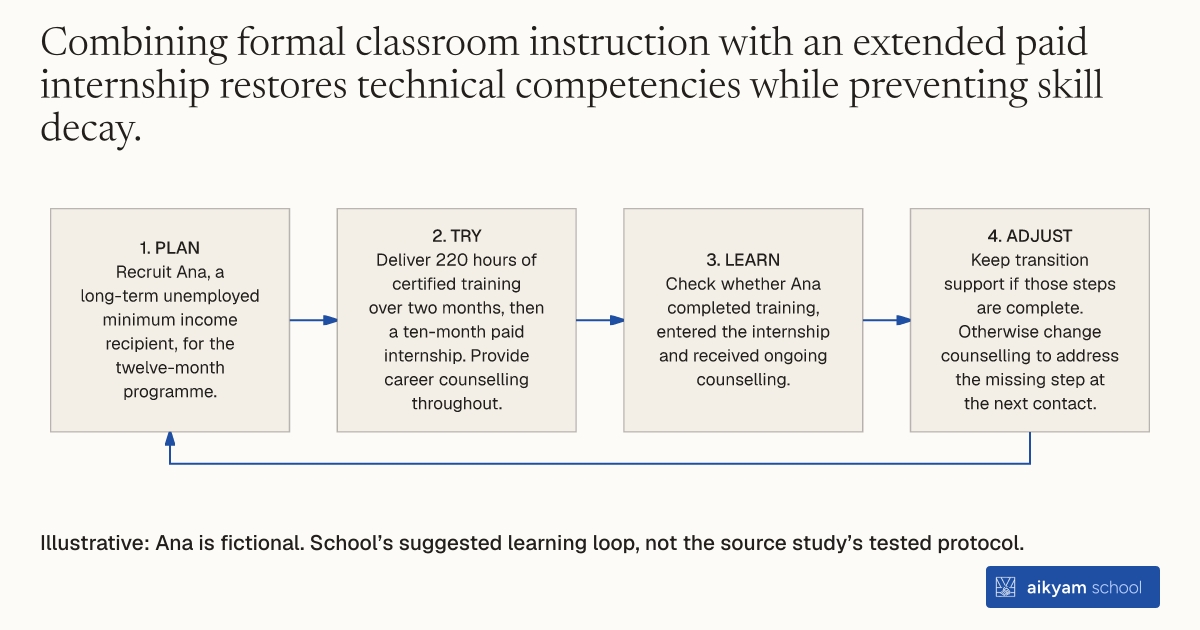
- Plan: Recruit Ana, a long-term unemployed minimum income recipient, for the twelve-month programme.
- Try: Deliver 220 hours of certified training over two months, then a ten-month paid internship. Provide career counselling throughout.
- Learn: Check whether Ana completed training, entered the internship and received ongoing counselling.
- Adjust: Keep transition support if those steps are complete. Otherwise change counselling to address the missing step at the next contact.
Illustrative: Ana is fictional. School’s suggested learning loop, not the source study’s tested protocol.
See source →School’s suggested, untested loop: observe training completion, internship placement and counselling; do not repeat the whole programme as a cycle.
How
When to use
Long-term unemployed workers face skills decay and diminished confidence when attempting to re-enter the labor market. Standard short-term job search assistance fails to provide accredited qualifications or long-term workplace experience. This method combines classroom vocational certification with an extended paid internship to restore competencies and improve job search behaviors among long-term unemployed adults.
Deliver certified classroom vocational training combined with a long-term paid internship and continuous counseling for long-term unemployed individuals.
- Public employment caseworkers recruit long-term unemployed beneficiaries of minimum income schemes for vocational retraining.
- Instructors lead a 220-hour certified vocational training course over two months to build specialized professional competencies.
- Program coordinators place participants in a ten-month paid internship at a host enterprise to gain practical workplace experience.
- Employment advisors deliver ongoing job search support and career counseling throughout the twelve-month program duration.
Why it works
Long-term workplace exposure boosts job search self-efficacy, proactivity, and career motivation.
Example
The Government of the Basque Country in Spain implemented a twelve-month inclusion program for 475 long-term unemployed individuals receiving minimum income benefits. Participants completed 220 hours of certified vocational training over two months followed by a ten-month paid internship with continuous career counseling. The program enhanced participants' professional competencies, self-efficacy, proactivity, motivation, job search skills, and overall job search attitudes.
About the study
Participants
475 long-term unemployed minimum income scheme recipients (199 treatment group, 276 comparison group) in the Basque Country, Spain.
Study Design
Randomised Controlled Trial (RCT) evaluating a 12-month program combining 220 hours of vocational training and a 10-month paid internship delivered by the Government of the Basque Country.
Results
Compared to standard public employment services, the program enhanced participants' professional competencies, self-efficacy, proactivity, motivation, job search skills, and overall job search behaviours and attitudes, with 86 percent completing training and 100 percent receiving counselling.