In Simple Words
Learning a complex trade solely through classroom lectures without practical experience is like reading a manual on swimming without entering the pool. Pairing a short, intense classroom certification course directly with a long-term paid position at a real workplace allows participants to immediately apply new skills in a real-world environment while regaining professional confidence.
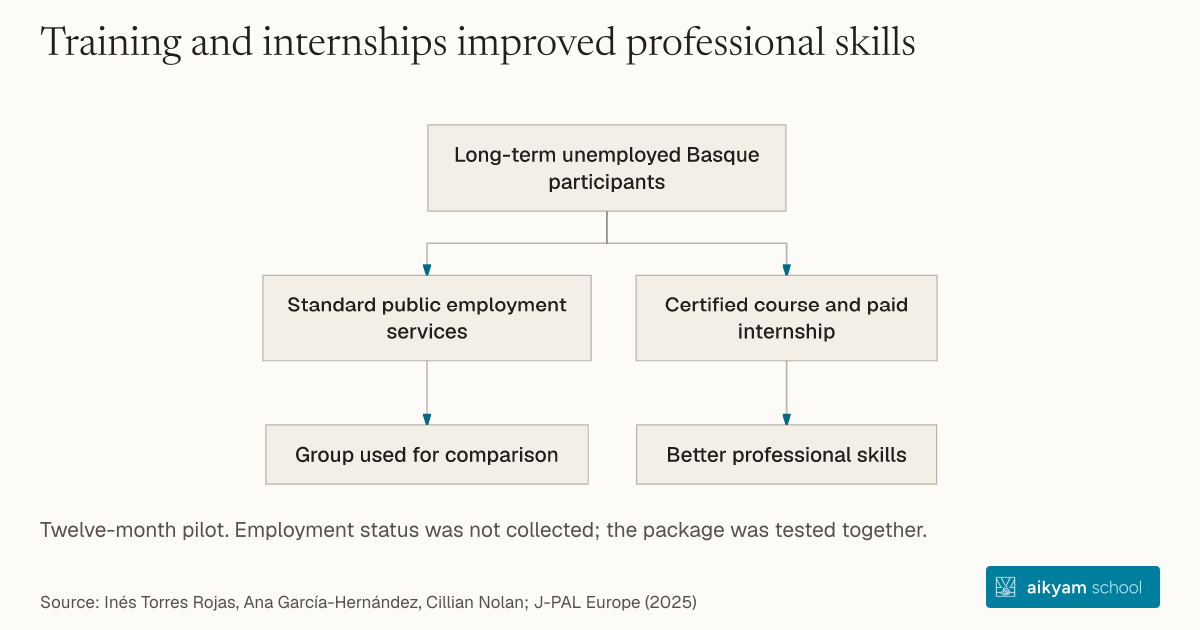
Long-term unemployed Basque participants
- Standard public employment services
- Group used for comparison
- Certified course and paid internship
- Better professional skills
Twelve-month pilot. Employment status was not collected; the package was tested together.
See source →Research question
Long-term unemployment degrades professional skill sets and erodes self-efficacy, causing workers on social assistance to become trapped in persistent social protection reliance.
Participants
475 long-term unemployed beneficiaries of minimum income schemes in the Basque Country, Spain (199 treatment, 276 comparison).
Study Design
Randomised Controlled Trial (RCT) evaluating a 12-month program combining a 2-month certified vocational course (220 hours) with a 10-month paid internship and continuous career counseling.
Results
Program take-up was exceptionally high (86% completed training), yielding statistically significant enhancements in acquired professional competencies, participant self-efficacy, job search proactivity, motivation, and overall job search strategies compared to standard public employment services.
Takeaway
Structure adult vocational re-skilling programs so that certified classroom instruction (200+ hours) is mandatorily paired with a multi-month paid corporate internship and continuous job placement support.
Source and citation
See source →Read alongside the research
Plain-English glossary
Original explanations, informed by the references below. Examples are illustrations, not data from the studies above. The research text stays unchanged.
- Randomized controlled trial
A study that uses chance, like drawing lots, to decide who receives each option being compared. Researchers compare the groups’ outcomes to estimate the effect of those options.
ExampleA lottery assigns volunteers to a training programme or a comparison group. Researchers then compare their outcomes.
GET-IT glossary · Randomized study ↗Read more about randomized controlled trial →- Statistically significant
A label used when a result passes a chosen statistical threshold, often p < 0.05. It does not show how large or useful an effect is. A result that is not statistically significant does not prove there is no effect.
ExampleA study reports p = 0.03 against a 0.05 threshold. It passes that test, but the effect could still be too small to matter.
American Statistical Association · Statement on p-values ↗Read more about statistically significant →