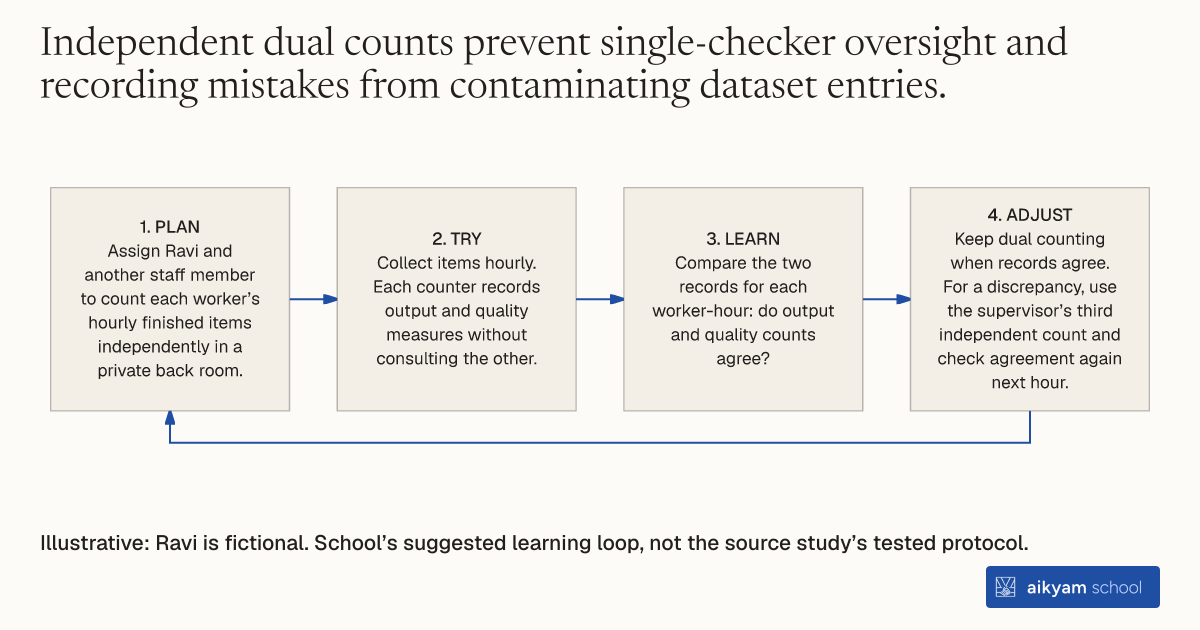
Try, learn and adjust
Check agreement between independent output counts
- Plan: Assign Ravi and another staff member to count each worker’s hourly finished items independently in a private back room.
- Try: Collect items hourly. Each counter records output and quality measures without consulting the other.
- Learn: Compare the two records for each worker-hour: do output and quality counts agree?
- Adjust: Keep dual counting when records agree. For a discrepancy, use the supervisor’s third independent count and check agreement again next hour.
Illustrative: Ravi is fictional. School’s suggested learning loop, not the source study’s tested protocol.
See source →School’s suggested, untested loop: observe independent counts and supervisor reconciliation; do not assume error-free data.
How
When to use
Record manufacturing output and quality metrics accurately without relying on single-checker tallying or worker self-reports. It solves the problem of human counting errors, bias, and worker disputes in piece-rate production systems. It serves project managers, quality control auditors, and field researchers conducting piece-rate production studies.
Verify hourly manufacturing output and quality metrics by using two independent counters and a supervisory reconciliation process.
- Collect finished manufactured items from worker stations at the end of every production hour under the routine premise of clearing work areas.
- Transfer the collected items directly to a secure back room isolated from worker view.
- Assign two research staff members to count total completed items and measure quality attributes independently without consulting each other.
- Compare the two recorded counts for every worker-hour slot to identify any numerical discrepancies.
- Have a supervisor perform a third independent count whenever a discrepancy occurs to determine the true final output tally.
Why it works
Independent supervisor reconciliation resolves discrepancies without introducing guesswork or relying on worker self-reports.
Example
At rural manufacturing facilities in Odisha, India, research staff collected completed leaf plates hourly from 408 piece-rate workers across 17,441 worker-hour slots. Two staff members counted accepted plates, rejected plates, double holes, leaves, and stitches independently in a private back room, with a supervisor performing a third count whenever discrepancies arose to ensure precise data accuracy.
About the study
Participants
408 male casual manufacturing workers aged 18 to 55 across 14 experimental rounds in Odisha, India (17,441 worker-hour production observations).
Study Design
Double-blind independent dual-counting of hourly accepted output and quality markers in a private room, with supervisory third-count reconciliation for discrepancies across treatment and control groups.
Results
Independent dual counting maintained complete data accuracy across 17,441 worker-hour slots, capturing a 6.9% output increase (0.109 SDs, p=0.020) and a 0.077 SD attentiveness increase (p=0.092) among cash-infused workers.