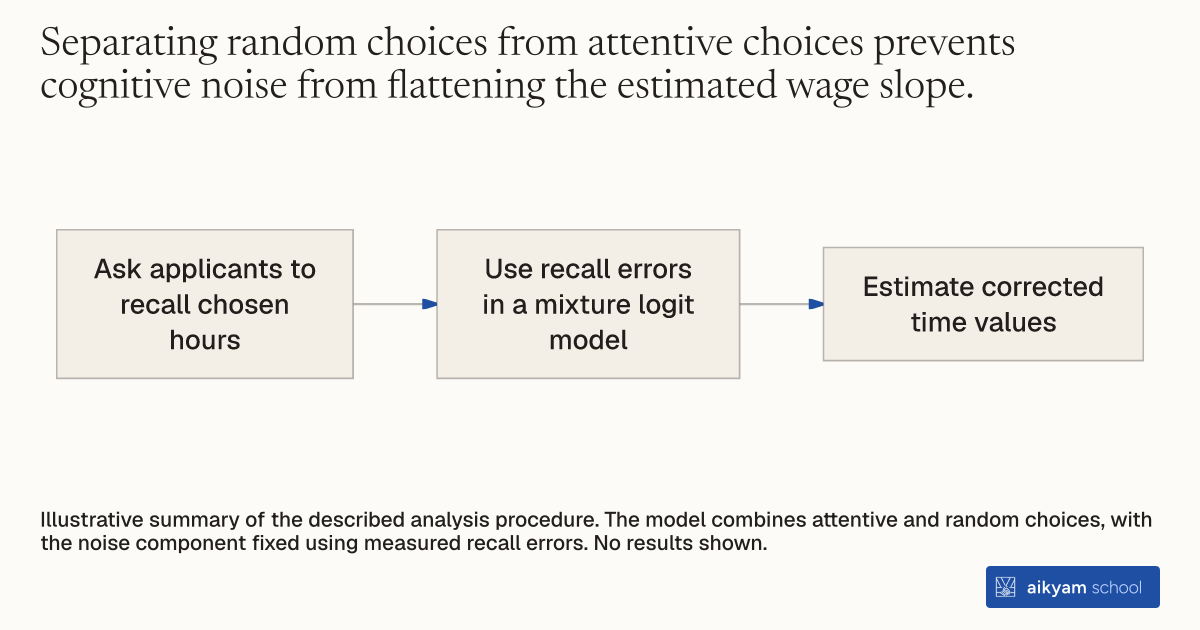
Research steps
Account for recall errors
- Ask applicants to recall chosen hours
- Use recall errors in a mixture logit model
- Estimate corrected time values
Illustrative summary of the described analysis procedure. The model combines attentive and random choices, with the noise component fixed using measured recall errors. No results shown.
See source →How
When to use
Online job application field experiments often suffer from participant inattention or accidental clicks. Researchers need a way to account for cognitive noise without discarding choice data or distorting baseline preference parameters. This method allows analysts to measure and correct for applicant inattention in discrete choice models.
Estimate a two-component mixture logit choice model using post-application recall error rates to correct for applicant inattention.
- Administer a follow-up survey question asking applicants to recall the weekly work hours of the position they selected.
- Calculate the proportion of applicants who incorrectly recall their selected position details to measure the baseline inattention rate.
- Formulate a two-component mixture logit model where choices combine attentive decisions and random choices.
- Estimate parameters using maximum likelihood while fixing the noise component to the measured inattention rate.
- Compute corrected marginal values of time by dividing the adjusted logit intercept by the slope parameter.
Why it works
This ensures structural parameter estimates reflect true applicant preferences rather than random guessing.
Example
Researchers evaluated job selections among 1,152 unemployed applicants across 80 U.S. metropolitan areas. Asking applicants to recall their chosen position revealed an inattention rate of 10.6 percent, and fitting a mixture model confirmed that inattention-corrected time valuations matched standard uncorrected estimates.
About the study
Participants
N = 1,152 unemployed job applicants (83% female, average age 32.7 years) across 80 U.S. metropolitan areas.
Study Design
Randomized field experiment combining a post-choice recall check with a two-component mixture logit model to correct for choice inattention.
Results
Post-application recall errors identified an inattention rate of 10.6 percent, and the resulting inattention-corrected flow value of time of 0.58 matched the standard uncorrected logit estimate of 0.58.