Research steps
Measure belief updating after forecast delivery
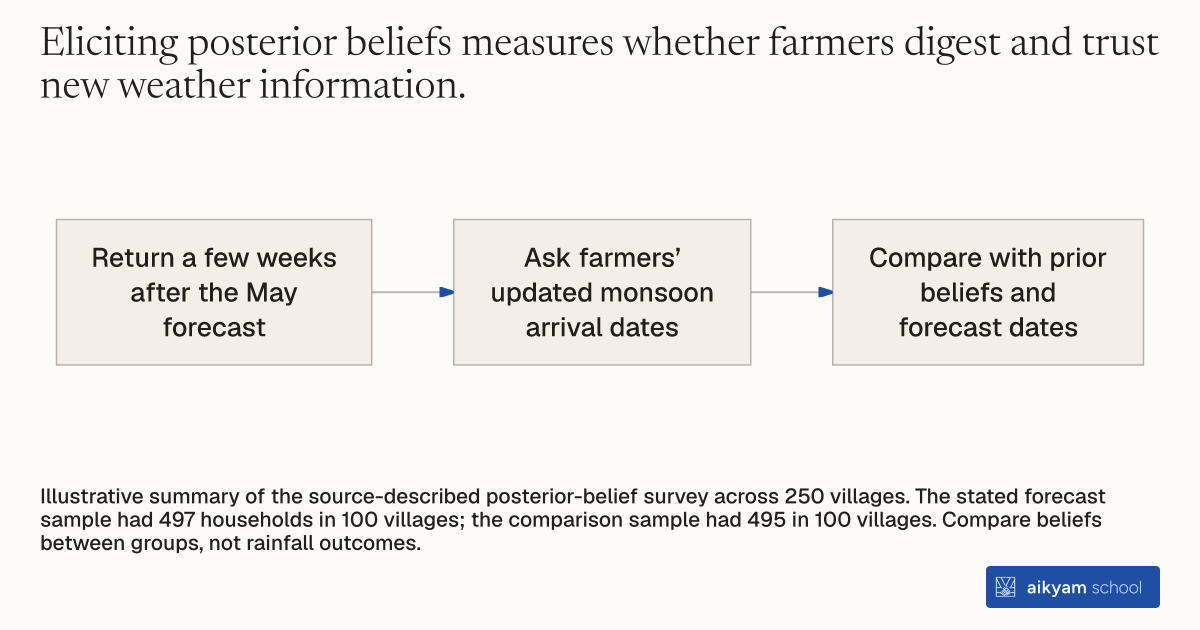
- Return a few weeks after the May forecast
- Ask farmers’ updated monsoon arrival dates
- Compare with prior beliefs and forecast dates
Illustrative summary of the source-described posterior-belief survey across 250 villages. The stated forecast sample had 497 households in 100 villages; the comparison sample had 495 in 100 villages. Compare beliefs between groups, not rainfall outcomes.
See source →How
When to use
Smallholder farmers receive long-range weather updates to guide production choices, but whether they accept new information remains uncertain. Measuring farmer expectations after information delivery quantifies how effectively forecasts update local climate beliefs. Re-surveying households several weeks after forecast distribution measures belief alignment before seasonal planting.
Re-survey farming households several weeks after delivering seasonal forecasts to evaluate information updating.
- Return to surveyed households a few weeks after initial forecast distribution in May.
- Elicit updated individual expectations regarding expected monsoon arrival dates.
- Compare posterior belief dates against baseline prior predictions and actual forecasted onset dates.
- Calculate belief convergence towards the forecasted date across forecast and comparison villages.
Why it works
Comparing updated expectations against baseline beliefs isolates how strongly information shifts individual probability distributions.
Example
Researchers returned a few weeks after May forecast delivery to elicit posterior beliefs from farmers across 250 villages in Telangana, India. Households that received seasonal forecasts updated monsoon arrival expectations 27 percent closer to the predicted onset date relative to comparison villages.
About the study
Participants
1,240 farming households across 250 villages in Telangana, India (497 forecast households in 100 villages, 495 comparison households in 100 villages).
Study Design
Re-surveying household beliefs a few weeks post-treatment during a Randomized Controlled Trial (RCT) evaluating seasonal forecast delivery.
Results
Forecast recipients updated monsoon arrival expectations to hold beliefs 27 percent closer to the forecasted onset date than comparison village households.