Try, learn and adjust
Check retirement outreach against contributions
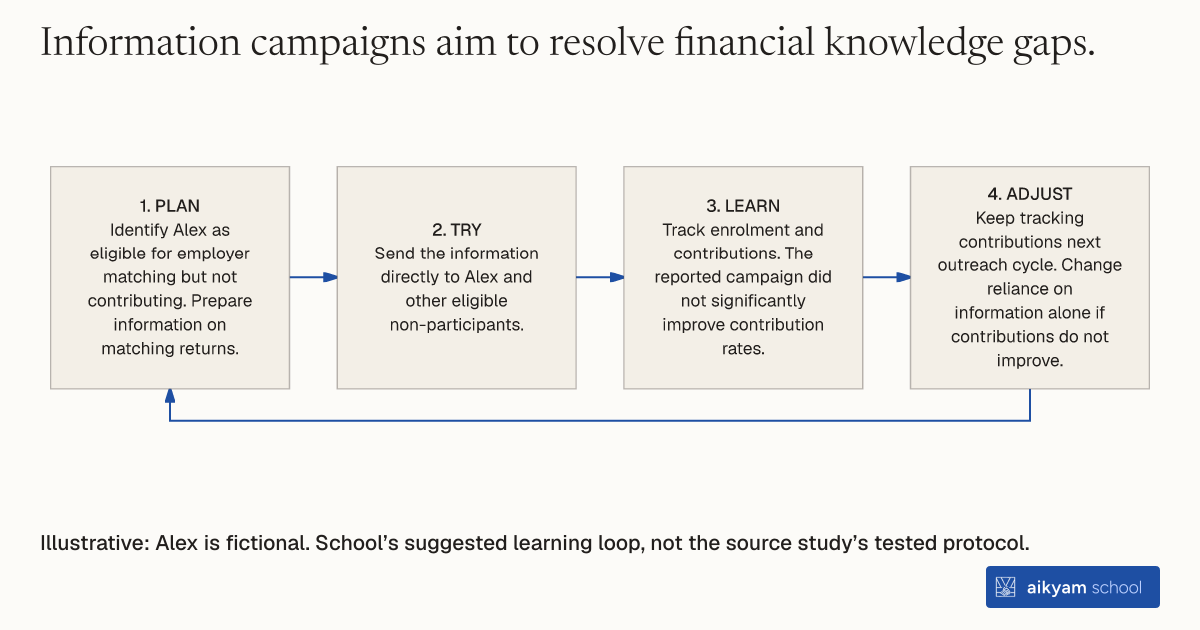
- Plan: Identify Alex as eligible for employer matching but not contributing. Prepare information on matching returns.
- Try: Send the information directly to Alex and other eligible non-participants.
- Learn: Track enrolment and contributions. The reported campaign did not significantly improve contribution rates.
- Adjust: Keep tracking contributions next outreach cycle. Change reliance on information alone if contributions do not improve.
Illustrative: Alex is fictional. School’s suggested learning loop, not the source study’s tested protocol.
See source →School’s suggested, untested loop. Observe enrolment and contribution rates; sending information does not establish behaviour change.
How
When to use
Many employees fail to enroll in high-return employer retirement savings matching programs despite the availability of matching funds. Organizations often deploy information campaigns under the assumption that non-participation stems from a lack of awareness. This method tests whether informational outreach increases retirement savings contribution rates among employees facing procrastination barriers.
Deliver informational campaigns regarding employer retirement savings matching programs to non-participating employees.
- Identify eligible corporate employees who fail to contribute to an employer retirement matching program.
- Design informational materials detailing the financial returns of taking advantage of the employer matching contribution.
- Distribute the information campaign materials directly to non-participating employees across participating firms.
- Track subsequent employee enrollment decisions and contribution rate changes in the retirement savings plan.
Why it works
However, when low contribution is caused by procrastination and self-control issues rather than lack of information, educational outreach does not alter behavior.
Example
Researchers evaluated an information campaign at several large firms in the United States where 36 percent of employees walked away from matching funds, finding that the information campaign failed to significantly improve contribution rates.
About the study
Participants
Corporate employees across several large firms in the United States where 36 percent of employees were missing matching funds.
Study Design
Randomized evaluation testing the impact of an informational campaign on retirement program enrollment.
Results
An information campaign did not significantly improve contribution rates, showing that procrastination rather than lack of information drove non-participation.