Try, learn and adjust
Check sorting quality before accepting output
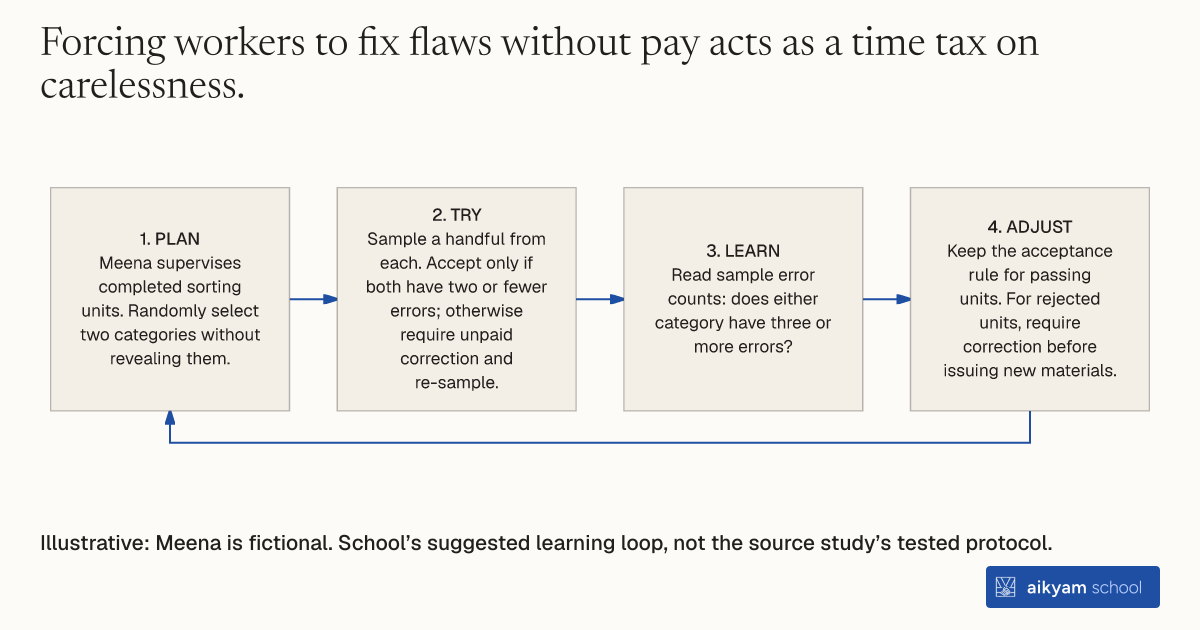
- Plan: Meena supervises completed sorting units. Randomly select two categories without revealing them.
- Try: Sample a handful from each. Accept only if both have two or fewer errors; otherwise require unpaid correction and re-sample.
- Learn: Read sample error counts: does either category have three or more errors?
- Adjust: Keep the acceptance rule for passing units. For rejected units, require correction before issuing new materials.
Illustrative: Meena is fictional. School’s suggested learning loop, not the source study’s tested protocol.
See source →School’s suggested learning loop checks sample errors and correction before acceptance, separately from the tested monitoring procedure.
How
When to use
Piece-rate payment schemes encourage workers to prioritize output speed over precision, leading to high sorting error rates. Employers paying by output quantity need a mechanism to maintain product quality without increasing baseline wage demands. This method applies to casual labor managers who oversee manual sorting or processing tasks.
Enforce quality standards on piece-rate output by conducting randomized category spot-checks and requiring unpaid error correction before issuing new units.
- Assign a supervisor to inspect completed output units individually as workers present them.
- Select two product categories at random from each completed unit without revealing the chosen categories to the worker.
- Draw a handful sample from each selected category and count the sorting errors.
- Accept the unit if each sample contains two or fewer errors.
- Reject the unit if either sample contains three or more errors.
- Require the worker to return to their workstation and correct all errors in the rejected unit without additional pay or new materials.
- Re-sample two randomly selected categories upon re-submission until the unit meets the approval threshold.
Why it works
Workers slow down and allocate more effort toward precision to avoid losing paid production time.
Example
Researchers tested this quality monitoring system with 612 casual day laborers across 12 rural Malawian villages sorting dried beans into eight categories. Half of the workers were assigned to explicit spot-checks while the other half worked unmonitored. Monitored workers reduced their average sorting errors significantly while taking longer to complete each unit.
About the study
Participants
612 contracted workers across 1,461 worker-day observations in 12 villages in rural Malawi (66.5% female, mean age 34.9 years).
Study Design
Randomized field trial assigning casual day laborers to explicit quality monitoring (random spot-checks of two categories per unit with mandatory error correction if three or more errors were detected) versus unmonitored piece-rate contracts.
Results
Quality monitoring decreases output quantity by 0.440 to 0.689 units per day (p < 0.01) while significantly improving quality by reducing sorting errors by 0.561 to 0.744 errors per unit (p < 0.01).