Research steps
Protect research participants and staff
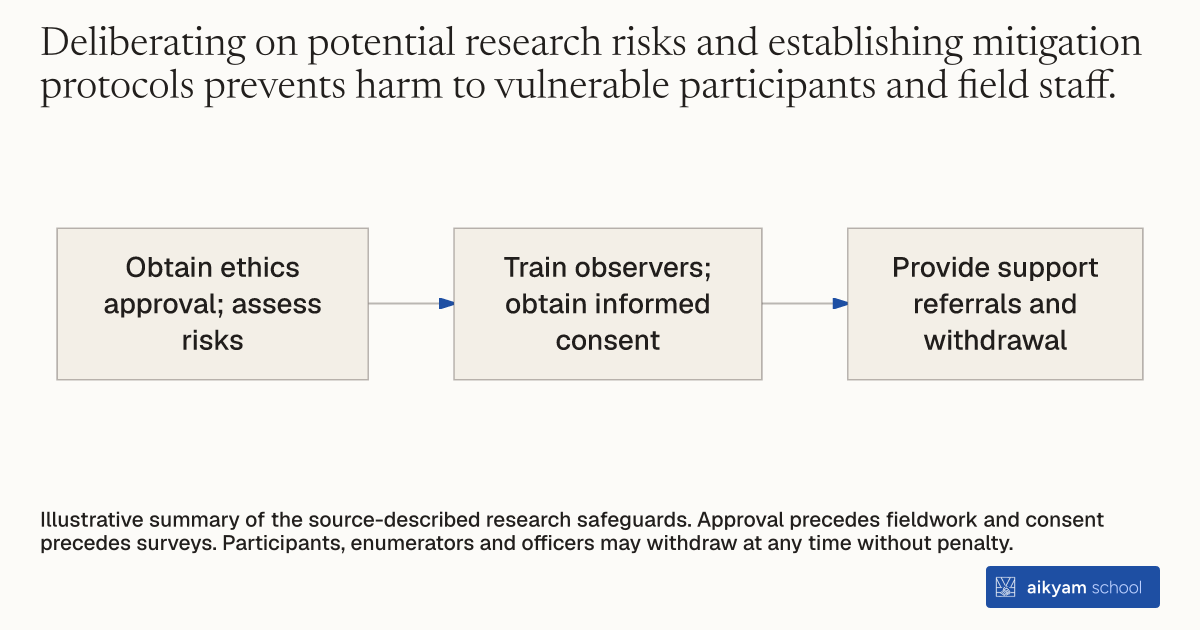
- Obtain ethics approval; assess risks
- Train observers; obtain informed consent
- Provide support referrals and withdrawal
Illustrative summary of the source-described research safeguards. Approval precedes fieldwork and consent precedes surveys. Participants, enumerators and officers may withdraw at any time without penalty.
See source →How
When to use
Field research and police evaluation studies on sexual violence involve significant ethical risks for participants, enumerators, and law enforcement personnel. Without deliberate ethical planning, data collection on sensitive topics can cause secondary trauma or exposure to physical danger. Implement a proactive risk mitigation framework to protect all research stakeholders throughout sensitive field evaluations.
Proactively define and execute ethical risk mitigation strategies across all research stakeholders during public safety evaluations.
- Obtain formal review and ethics approval from an institutional review board before starting field research.
- Conduct a comprehensive risk assessment to identify potential harms to enumerators, police officers, and female participants.
- Provide specialized safety and protocol training to enumerators monitoring public harassment.
- Secure informed consent from all research participants prior to survey administration.
- Provide referral mechanisms to professional support services for participants or enumerators affected by harassment.
- Establish explicit withdrawal rights allowing any stakeholder to opt out of participation at any time without penalty.
Why it works
Providing informed consent, support services, and withdrawal rights maintains ethical standards while gathering sensitive data.
Example
Researchers studying the Hyderabad City Police patrolling program in Hyderabad, India, established an institutional review board-approved ethical framework protecting enumerators, officers, and female participants across 350 study hotspots.
About the study
Participants
350 hotspots and study participants in Hyderabad, India.
Study Design
Proactive ethical review and risk mitigation framework integrated into a randomized controlled trial evaluating street police patrolling.
Results
Integrating formal ethics approval, informed consent, safety training, support service referrals, and withdrawal rights enabled safe evaluation across 350 hotspots while maintaining high data collection standards.