Research procedure
Observe community action in context
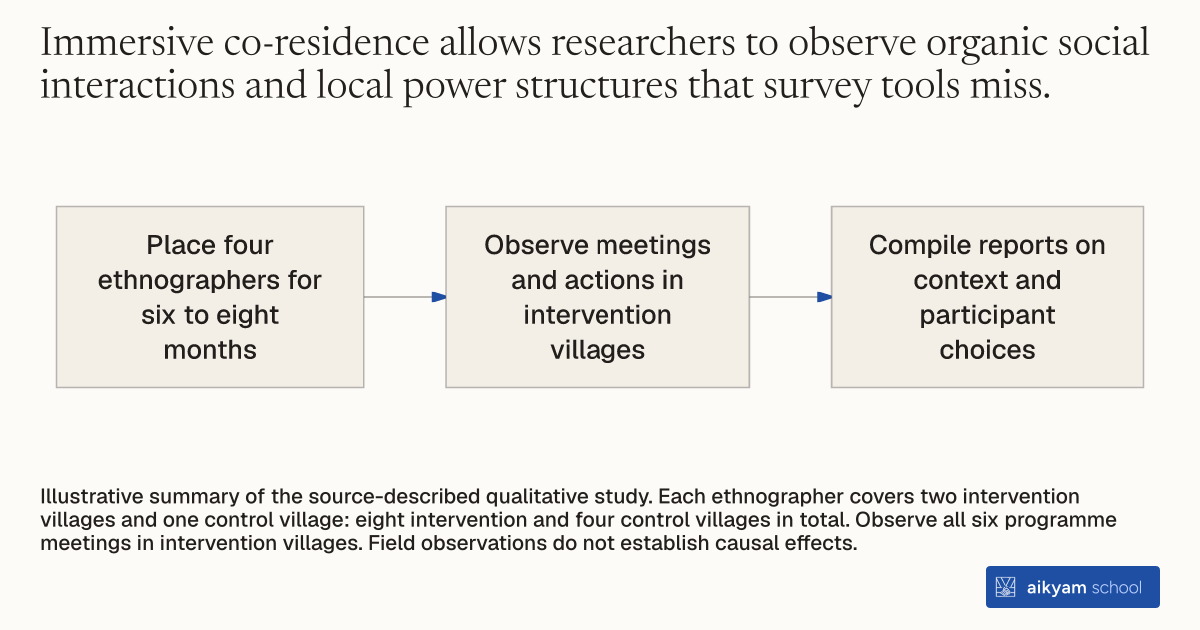
- Place four ethnographers for six to eight months
- Observe meetings and actions in intervention villages
- Compile reports on context and participant choices
Illustrative summary of the source-described qualitative study. Each ethnographer covers two intervention villages and one control village: eight intervention and four control villages in total. Observe all six programme meetings in intervention villages. Field observations do not establish causal effects.
See source →How
When to use
Program evaluators and researchers need qualitative context on how rural citizens participate in civic deliberation and carry out social action plans. Quantitative metrics alone cannot capture local history, facilitator dynamics, or cultural norms that shape participant choices. Researchers deploy ethnographic observation to observe village meeting dynamics and explain why communities choose specific social actions.
Deploy qualitative researchers to conduct long-term immersive field observation across selected intervention and control villages.
- Recruit trained ethnographers to live continuously in target rural communities for six to eight months during program implementation.
- Assign each ethnographer to observe two intervention villages and one control village within the study region.
- Attend all six T4D program meetings in intervention villages to record participant interactions, power dynamics, and facilitator styles.
- Track village social action implementation in real time by observing community members as they execute planned steps.
- Compile detailed ethnographic field reports capturing local history, political dynamics, and cultural factors influencing citizen choices.
Why it works
Qualitative observation reveals how historical memories of past development programs and facilitator teaching styles directly shape participant behavior.
Example
Four ethnographers lived in eight intervention and four control communities in Indonesia and Tanzania for six to eight months during the T4D program, generating field reports that explained observed national differences—such as Tanzanian facilitators acting like authoritative teachers and Tanzanians expecting government Magufuli loans for group entrepreneurship.
About the study
Participants
Four ethnographic researchers living across eight intervention and four control villages in Indonesia and Tanzania over a six to eight month period.
Study Design
Immersive qualitative field study embedded within two randomized controlled trials, observing six program meetings per intervention village and tracking community social action execution.
Results
Ethnographic observation revealed key contextual drivers of program choices, explaining why 18.0% of Indonesian villages designed non-health system community solutions while 0.0% did in Tanzania, and why Tanzanian communities favored punitive bylaws.