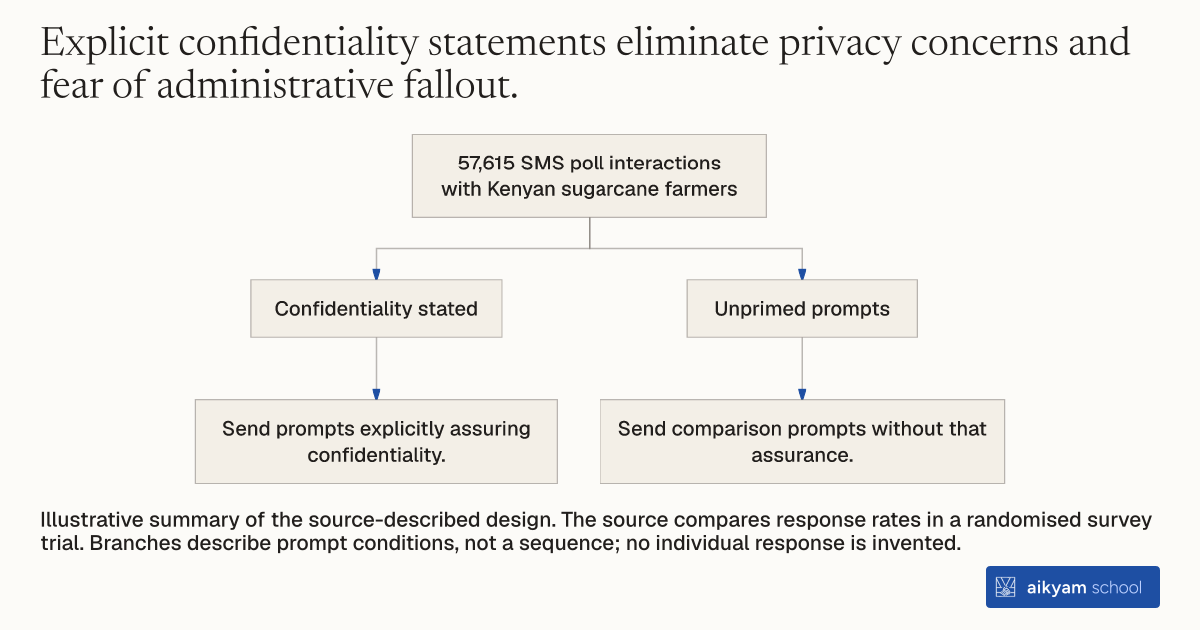
Research design
Compare confidentiality prompts
57,615 SMS poll interactions with Kenyan sugarcane farmers
- Confidentiality stated
- Send prompts explicitly assuring confidentiality.
- Unprimed prompts
- Send comparison prompts without that assurance.
Illustrative summary of the source-described design. The source compares response rates in a randomised survey trial. Branches describe prompt conditions, not a sequence; no individual response is invented.
See source →How
When to use
Contract farmers often hesitate to participate in mobile survey polls due to privacy concerns or fears that personal data will be used administratively against them. Explicitly assuring confidentiality within survey prompts reassures respondents and reduces suspicion. It serves smallholder farmers participating in agricultural value chains and digital monitoring programs.
Explicitly prime mobile survey respondents with a clear confidentiality statement before asking questions.
- Formulate concise survey queries to gather operational or demographic data from smallholders.
- Insert an explicit statement into the message text assuring recipients that their responses are strictly confidential.
- System administrators broadcast the primed survey prompt to registered farmers via text message.
- Program servers record and store incoming text responses securely while maintaining respondent privacy.
Why it works
Reassuring respondents that their data is protected encourages participation and honest reporting.
Example
Innovations for Poverty Action and Mumias Sugar Company evaluated response rates across 57,615 SMS poll interactions with smallholder sugarcane farmers in Western Kenya. Including an explicit statement of confidentiality in SMS poll prompts increased farmer participation rates by 5.8 percentage points over unprimed control prompts.
About the study
Participants
57,615 SMS poll interactions sent to smallholder sugarcane farmers in Western Kenya.
Study Design
Randomized survey trial comparing response rates when text survey prompts explicitly included a confidentiality assurance versus unprimed controls.
Results
Explicitly stating confidentiality in text survey prompts increased farmer response rates by 5.8 percentage points (p < 0.01).