Research steps
Measure harvests from weighbridge records
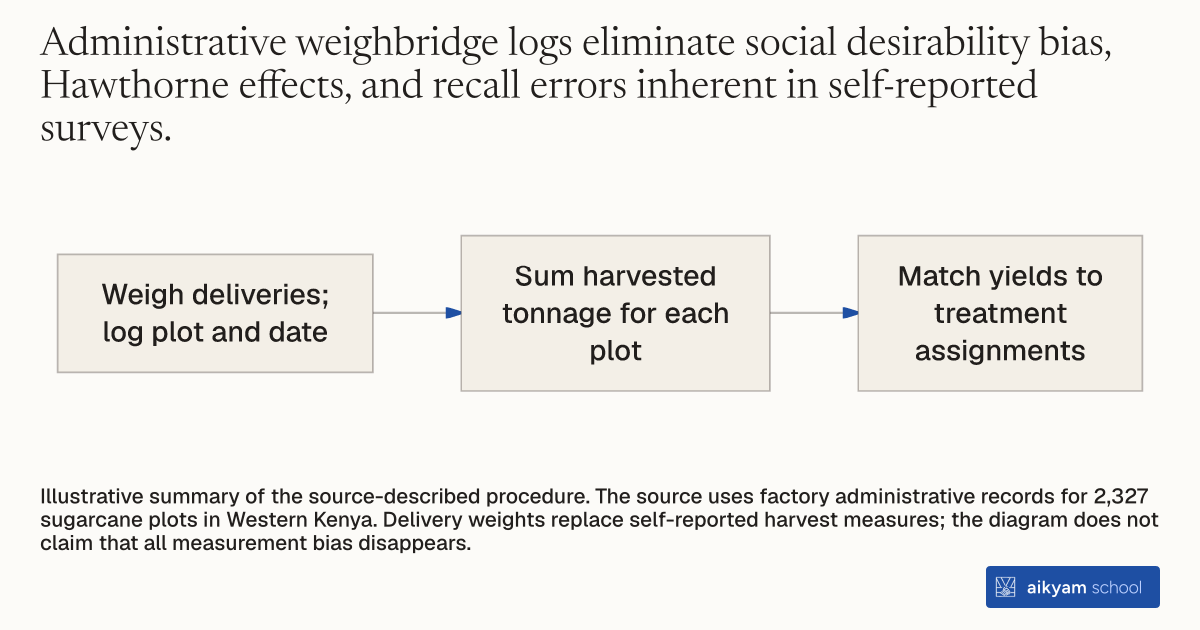
- Weigh deliveries; log plot and date
- Sum harvested tonnage for each plot
- Match yields to treatment assignments
Illustrative summary of the source-described procedure. The source uses factory administrative records for 2,327 sugarcane plots in Western Kenya. Delivery weights replace self-reported harvest measures; the diagram does not claim that all measurement bias disappears.
See source →How
When to use
Agricultural extension evaluations relying on farmer survey self-reports suffer from social desirability bias and memory recall errors. Farmers often report adopting recommended practices or higher yields regardless of actual performance. Tracking crop deliveries through factory weighbridge records provides objective data for evaluating agricultural interventions.
Track harvest yields using sugar factory weighbridge administrative data to evaluate program impacts without survey bias.
- Sugarcane processing company staff weigh incoming crop harvest trucks at official factory weighbridge stations.
- Weighbridge operators log the exact net weight, delivery date, and plot identifier for each sugarcane delivery.
- Program researchers aggregate individual delivery records by plot to calculate total harvested tonnage per plot.
- Analysts match plot yield data against treatment assignment lists to compute unbiased treatment effects.
Why it works
Factory records measure actual marketed production precisely at the point of sale.
Example
Mumias Sugar Company and researchers evaluated 2,327 sugarcane plots in Western Kenya using factory weighbridge administrative records. Tracking harvest weights at the factory weighbridge measured an unbiased yield gain of 3.33 tons per hectare among SMS treatment plots without survey recall errors.
About the study
Participants
2,327 smallholder sugarcane plots tracked across sugar company factory records in Western Kenya.
Study Design
Randomized Controlled Trial evaluating yield outcomes via objective administrative weighbridge records rather than farmer self-reports.
Results
Evaluated program impacts using objective administrative weighbridge data, measuring an intent-to-treat yield increase of 3.33 tons per hectare (p < 0.05) while eliminating Hawthorne effects and social desirability bias.