Try, learn and adjust
Check rental access alongside extension duties
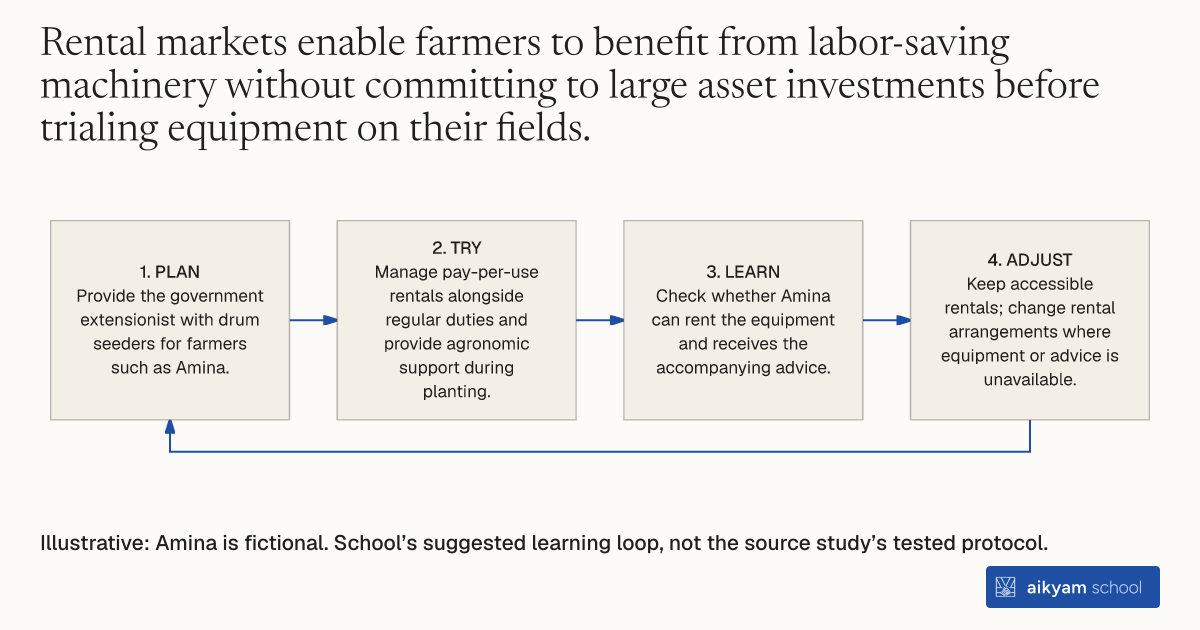
- Plan: Provide the government extensionist with drum seeders for farmers such as Amina.
- Try: Manage pay-per-use rentals alongside regular duties and provide agronomic support during planting.
- Learn: Check whether Amina can rent the equipment and receives the accompanying advice.
- Adjust: Keep accessible rentals; change rental arrangements where equipment or advice is unavailable.
Illustrative: Amina is fictional. School’s suggested learning loop, not the source study’s tested protocol.
See source →Observe access and advisory support. The source assigns 103 villages to this arrangement; adoption and sustainability results remain forthcoming. School suggests this learning loop; it was not tested by the source.
How
When to use
Small-scale farmers often cannot afford to buy expensive farm machinery outright. Renting equipment allows farmers to use new technologies without high upfront costs. Government extension agents can manage equipment rental access in addition to their regular duties.
Offer smallholder farmers pay-per-use rental access to agricultural machinery through government-employed extension agents.
- The government department provides drum seeders to government-employed agricultural extensionists in designated villages.
- The extensionist manages equipment rentals for local small-scale farmers alongside their daily responsibilities.
- The extensionist provides agronomic information and support to farmers renting the machinery.
- Smallholders rent the drum seeders to plant rice during the planting season.
Why it works
Extension agents already work directly with rural communities to share agricultural knowledge and support adoption.
Example
Government extensionists managed rental drum seeders for smallholder farmers cultivating 2 hectares or less across 103 villages in Telangana, India.
About the study
Participants
103 assigned villages out of 400 total evaluation villages in Telangana, India, where farmers cultivate 2 hectares or less and 70 percent of rural households depend on agriculture.
Study Design
Randomized controlled trial comparing extensionist-managed rentals across 103 villages against 102 leader-managed villages and 156 status quo comparison villages using baseline, phone, and in-person surveys.
Results
Extensionists managed rental drum seeders alongside their day-to-day duties across 103 villages; study results on farmer technology adoption and rental market sustainability are ongoing and forthcoming.