Research steps
Track seed adoption across seasons
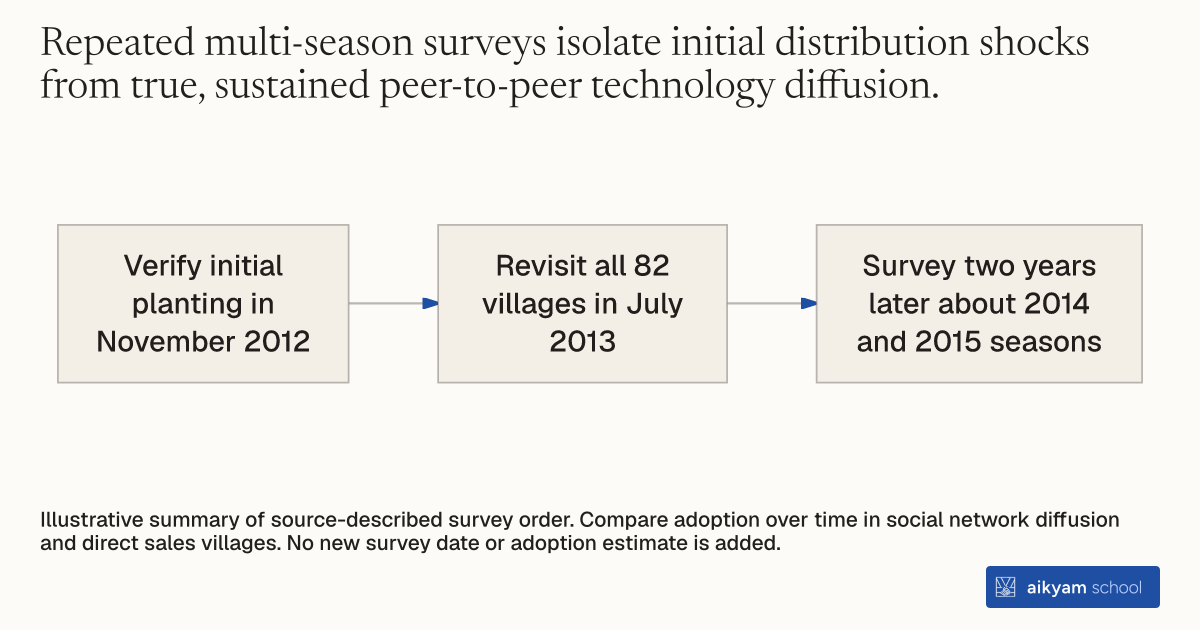
- Verify initial planting in November 2012
- Revisit all 82 villages in July 2013
- Survey two years later about 2014 and 2015 seasons
Illustrative summary of source-described survey order. Compare adoption over time in social network diffusion and direct sales villages. No new survey date or adoption estimate is added.
See source →How
When to use
Agricultural technology programs often measure adoption immediately after distribution, missing long-term dynamics. Evaluating technology uptake requires multi-year tracking to see if peer diffusion gaps narrow or persist over subsequent growing seasons. Longitudinal survey tracking across multiple agricultural cycles reveals sustained technology adoption rates for smallholder farmers.
Track technology adoption across multiple agricultural planting cycles using structured follow-up surveys.
- Field enumerators visit target villages during the harvesting period in November 2012 to verify initial planting.
- Enumerators revisit all study villages in July 2013 to survey farmers during the next planting season.
- Field teams administer a final survey two years later to track long-term adoption across the 2014 and 2015 seasons.
- Analysts compare adoption percentages between social network diffusion communities and direct sales communities over time.
Why it works
Tracking over multiple years reveals whether informal social exchanges eventually overcome initial market frictions.
Example
Researchers conducted follow-up survey rounds across 82 villages in Bhadrak district, Odisha, India, in July 2013 and two years later for the 2014 and 2015 seasons to track Swarna-Sub1 adoption persistence.
About the study
Participants
82 rural villages in Bhadrak district, Odisha, India.
Study Design
Longitudinal field survey tracking adoption in November 2012, July 2013, and two years later across the 2014 and 2015 seasons across social network and door-to-door benchmark villages.
Results
Multi-season tracking revealed that organic network adoption reached 7 percent compared to 41 percent in door-to-door sales villages, with the adoption gap narrowing over time but remaining significant after two additional seasons.